
Handle-free fronts can open through a finger recess, a mechanical push or powered assistance. They may look similar while asking the user to do quite different things.
Here we compare the opening actions and maintenance demands, including when a small conventional pull remains the comfortable solution.
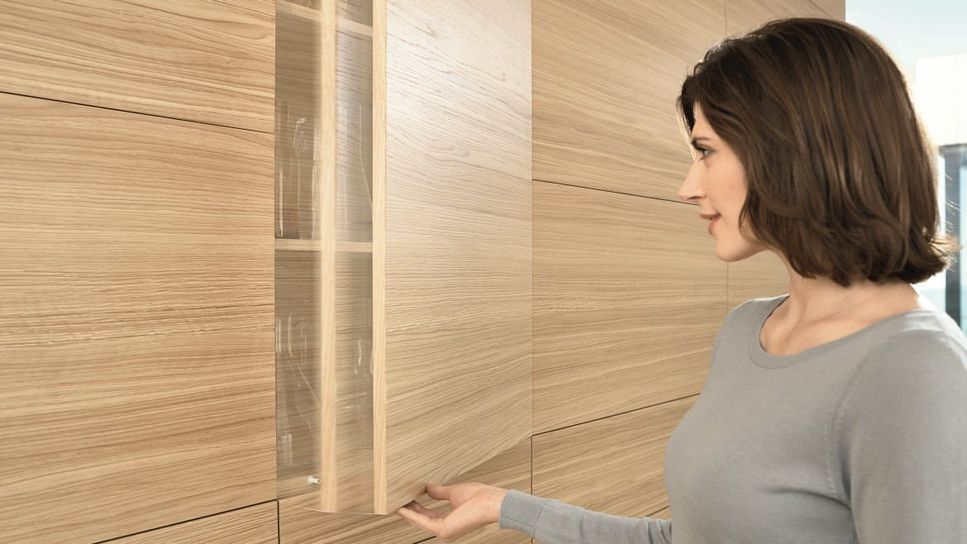
Do not buy push opening and assume soft closing
Blum TIP-ON ↗ is a mechanical push-opening example. The exact application determines its compatible components. A push-open description alone does not establish soft closing; combined functions require a system intended to provide them.
A shaped finger grip has no opening actuator to specify, although its machining and profile still have a cost. A continuous recess changes the furniture construction and the grip position. Compare a loaded sample of each with the household’s normal reach and hand movement. A small external pull can be easier to operate on a demanding appliance front than an inconsistent all-handle-free scheme.
Choose the opening action first
Handle-free furniture describes an appearance, not one opening method. A shaped finger pull, a continuous recessed profile and a push-to-open latch ask the user to do different things. Try the movement with wet hands, a cloth and the normal contents of the cabinet.
Do not choose every opening by the same visual rule. A heavy wide drawer, a refrigerator front and a small wall cupboard may need different solutions. Confirm compatibility with integrated appliances rather than assuming an ordinary cabinet latch can operate them.
Recessed grips still need hand space
A recessed profile gives fingers a place to pull without a projecting handle. Its position, depth and edge shape affect comfort. Check that the grip is usable at low and high levels and that adjacent fronts leave enough access.
Profiles and shaped edges can reduce some usable storage or front area. Include them in the cabinet drawing rather than adding them after dimensions are fixed. Look at the cleaning path along the recess and around corners where crumbs can collect.
Push-to-open depends on the right components
Blum TIP-ON is a manufacturer example of mechanical opening assistance. Different applications have specific requirements, including front gaps and compatible hinges or runners. Soft closing and push opening are separate functions unless the selected system is designed to combine them.
Ask for the exact component combination and adjustment procedure. A poorly aligned front can make a good mechanism feel unreliable. Test a loaded sample if possible and check how accidental pressure from someone leaning against the cabinet is handled in the chosen location.
Consider maintenance and a simpler alternative
Frequently touched fronts can show marks. Compare the actual finish under kitchen lighting and use its cleaning instructions. Anti-fingerprint descriptions are product-specific and should not be read as a promise that a surface never needs wiping.
A small conventional pull may be the most practical choice for a difficult door. Before ordering a full kitchen, test the grip, opening force, front clearances and adjustment access. The aim is a clean appearance that remains comfortable to operate.
The linked products are examples of different approaches. Similar solutions can be found from other manufacturers and stores. Compare the exact model, supplied components and installation requirements. Product photographs are credited to their source. This article describes functions and planning considerations, rather than a hands-on test.