
Belts, ties, scarves and other closet accessories may be small, yet keeping them organized can be surprisingly difficult. Purpose-built storage can help you use space more efficiently and make everyday accessories easier to reach.
In this guide, we explore different ways to store them, from simple hangers and hooks to pull-out racks and fitted drawer inserts. We explain how each approach works, what it makes easier and how much space it needs, so you can choose a solution that suits your closet and budget.
IDEA 01
A hanger on your existing rod: a simple start without drilling
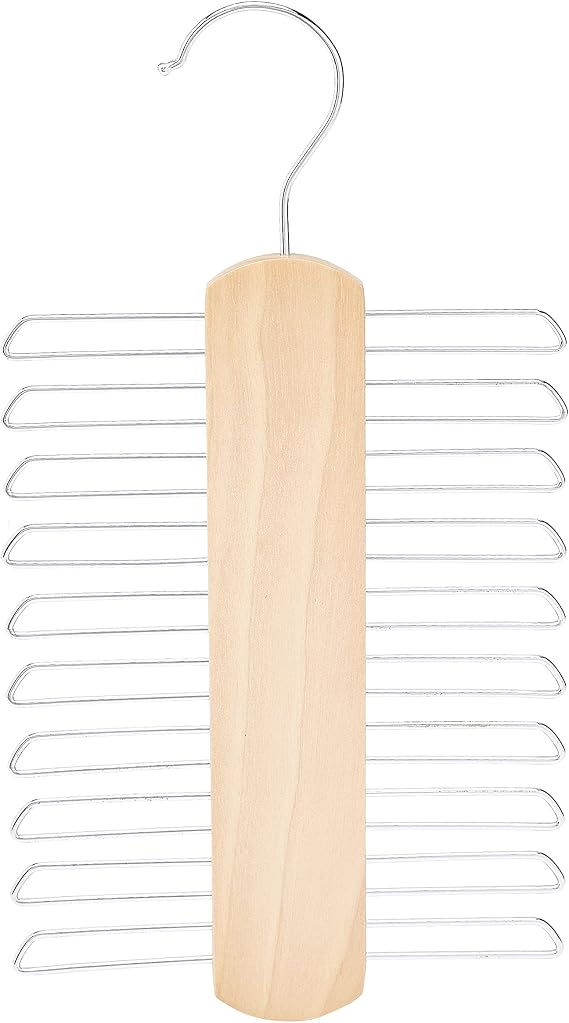
You do not always need to install new hardware. A dedicated accessory hanger fits onto an existing closet rod. You can also lift it out and view its contents away from the clothes around it.
This is especially useful in a rental home, a ready-made wardrobe or when you want an inexpensive way to find out which storage arrangement works for you.
One example is the Amazon Basics 20 Bar Wooden Tie Hanger & Belt Rack, sold as a two-pack. Its wooden body and metal arms separate ties instead of piling them onto an ordinary clothes hanger. The listed price when checked was $8.99 for the two-pack. Example on Amazon ↗.
Its main limitation is its position among your clothes. If it is squeezed between jackets, you still need to move them aside before choosing a tie. Leaving some arms empty can also be more convenient than layering several accessories onto every available space.
When does it make sense? When you want a simple, inexpensive solution without altering the cabinetry.
Similar hangers are available from other brands and retailers. This product illustrates the approach; compare arm spacing, surface finish and how easily you can remove one accessory.
IDEA 02
Individual hooks: make use of small, empty spaces
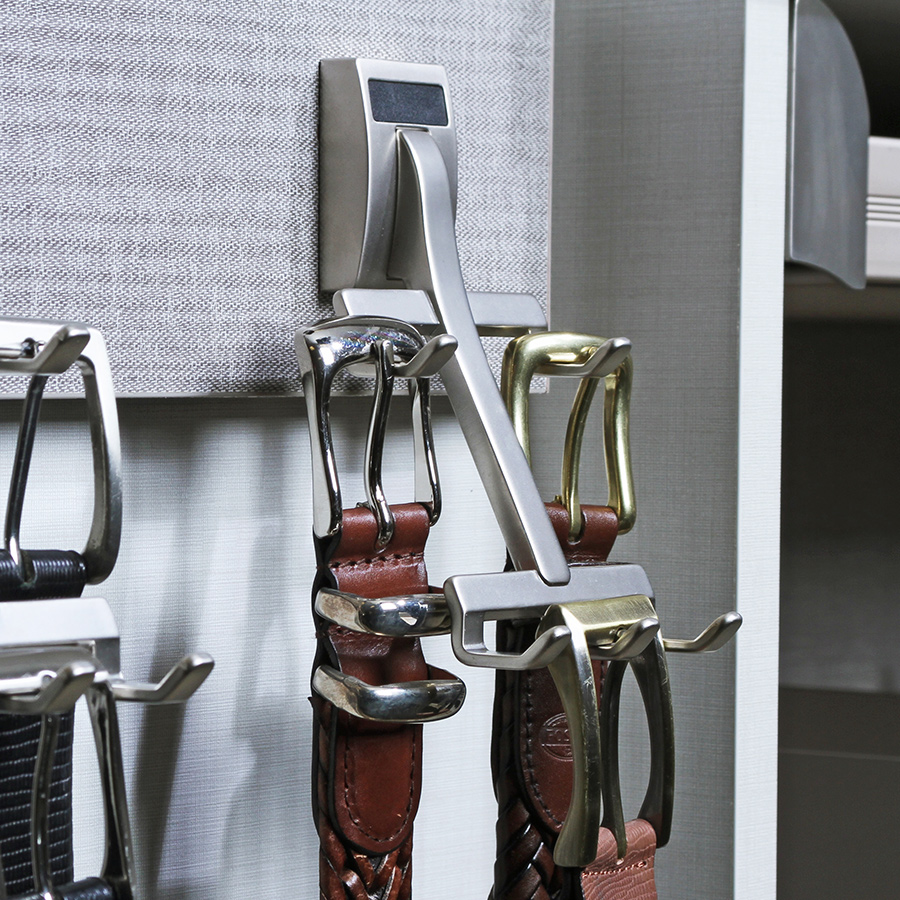
A narrow section of wall or a mounting board may be enough to store several accessories. Individual hooks let you place them in different parts of the closet, including spaces too small for a long rack.
The shape of the support matters. A belt buckle needs a different hanging point from a draped tie or scarf.
TAG offers a Belt Hook, designed to hold at least five belts according to the manufacturer, and a separate Tie Hook, described as holding eight ties. These are different products with different support shapes. Example: TAG Belt Hook ↗.
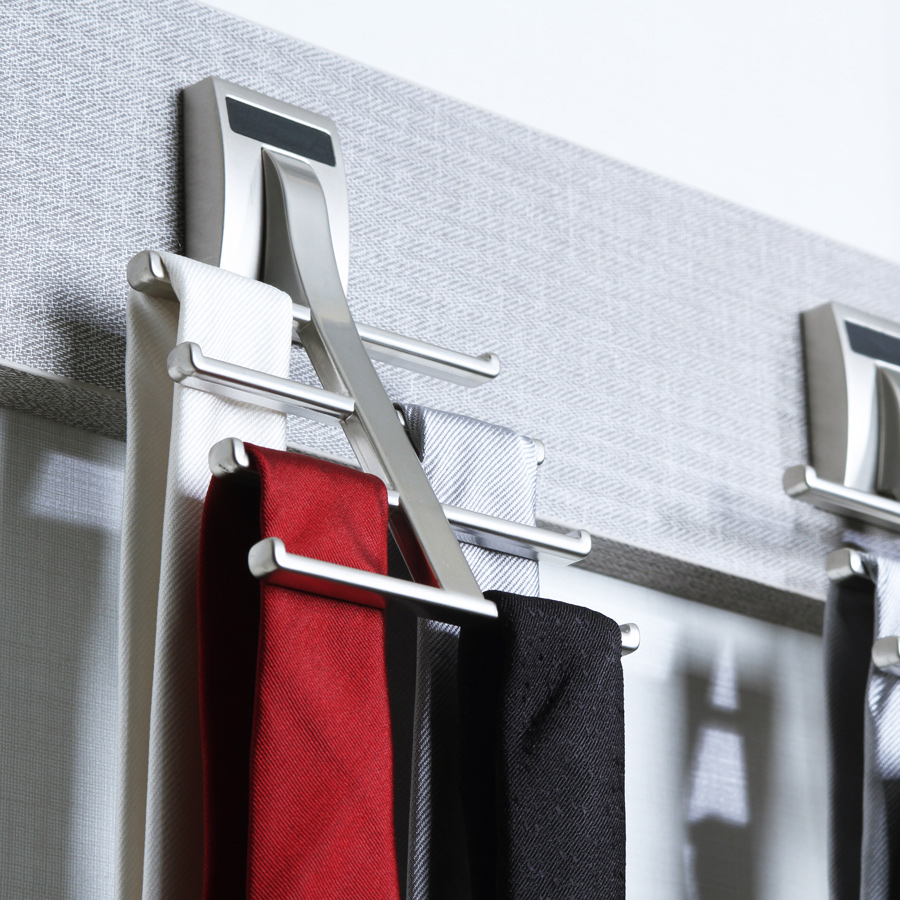
These fittings can also display accessories. In an open closet, a coordinated finish becomes part of the room’s design. However, filling a hook to its maximum capacity may make individual items harder to reach. Several belts hung behind one another use little width, but removing the back one can mean moving those in front. Example: TAG Tie Hook ↗.
Check the mounting arrangement before buying. The Belt Hook is described as cleat-mounted, so confirm the required supporting surface and mounting components. Also allow for the length of the hanging belts: a small hook may need considerable clear space below it.
When does it make sense? When you want to use a small area or keep a few frequently worn accessories within easy reach.
Other manufacturers offer similar functions. Compare the support shape, surface quality and mounting method as well as the appearance.
IDEA 03
A fixed rack: see your accessories immediately
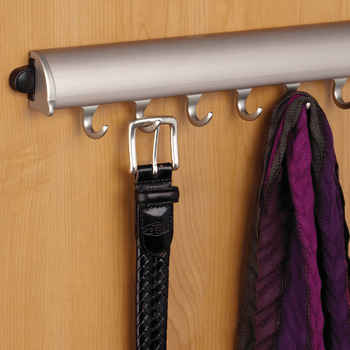
If you have an exposed cabinet side or an accessible wall, a fixed rack lets you arrange accessories alongside one another. There is nothing to pull out or turn before viewing the contents.
The TAG Accessory Rack – Fixed is one example. The manufacturer offers nominal 14- and 18-inch lengths and several finishes, including black, matte gold and polished chrome. This can help coordinate the fitting with other elements in the closet. Example: TAG Accessory Rack – Fixed ↗.
Its location determines how convenient it will be. A rack mounted behind coats remains difficult to reach. On the inside of a door, it may collide with shelves or the closet contents when the door closes.
For door mounting, check the door’s construction, suitable fixing points and screw length. Leave enough space between accessories, particularly those with large buckles.
When does it make sense? When you already have an accessible surface and want to see accessories without operating a mechanism.
Simpler racks from other brands can serve the same purpose. A designer fitting is worth considering when coordinated finishes and appearance matter alongside organization.
IDEA 04
Full-extension racks: bring accessories out from behind clothes
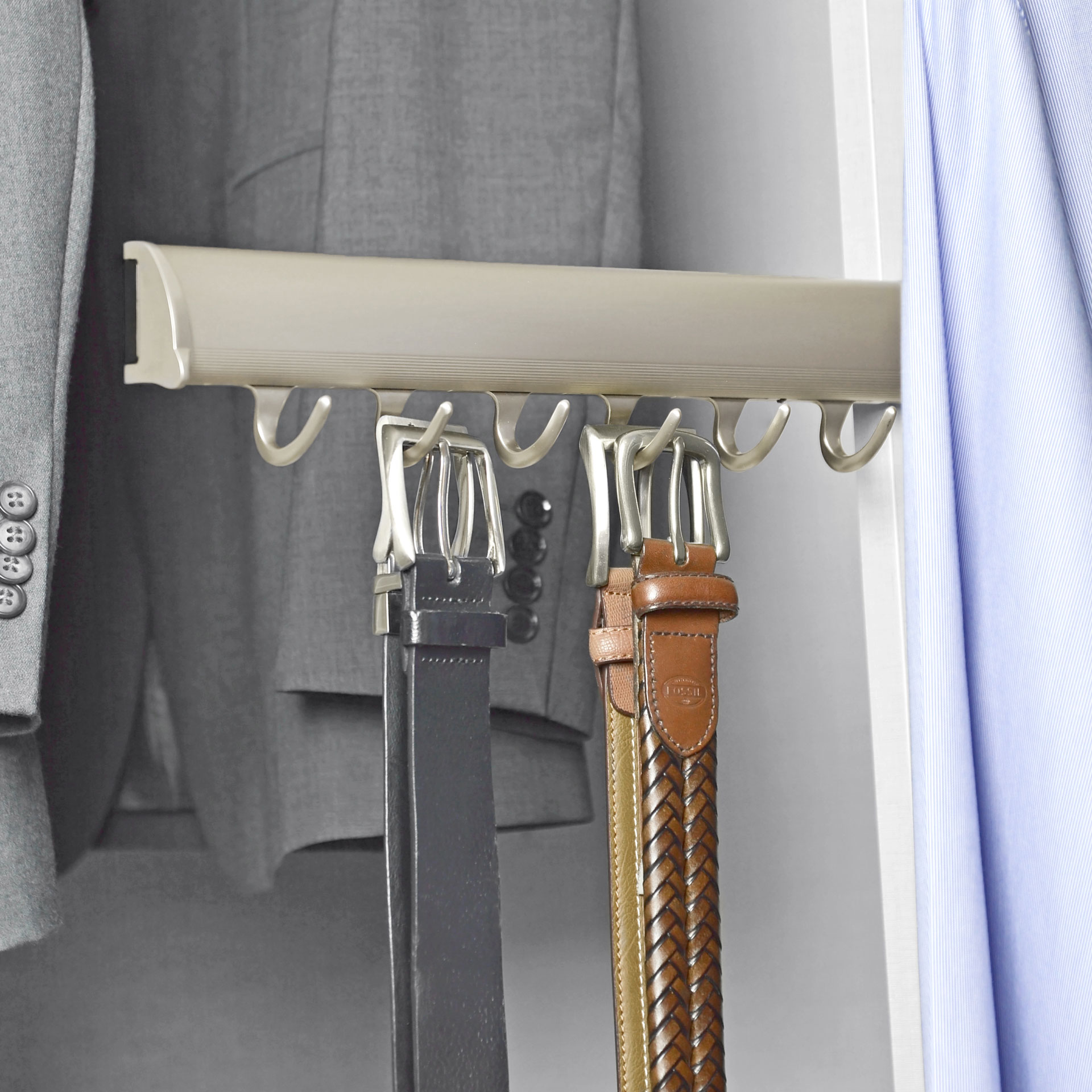
A cabinet side can provide useful storage space, but it often becomes difficult to reach once clothes are hanging beside it. A sliding rack brings the accessories forwards for selection, then returns them to the cabinet.
The TAG Belt Rack – Full Extension uses a full-extension ball-bearing slide. Several lengths are available, and the manufacturer allows up to three belts per hook. That provides additional capacity, although one belt per hook generally makes individual items easier to see and remove. Example: TAG Belt Rack – Full Extension ↗.
The same family includes a Tie Rack – Full Extension, with supports intended for draped ties. Their coordinated appearance helps create a consistent look, but you still need the version suited to the accessories you plan to store.
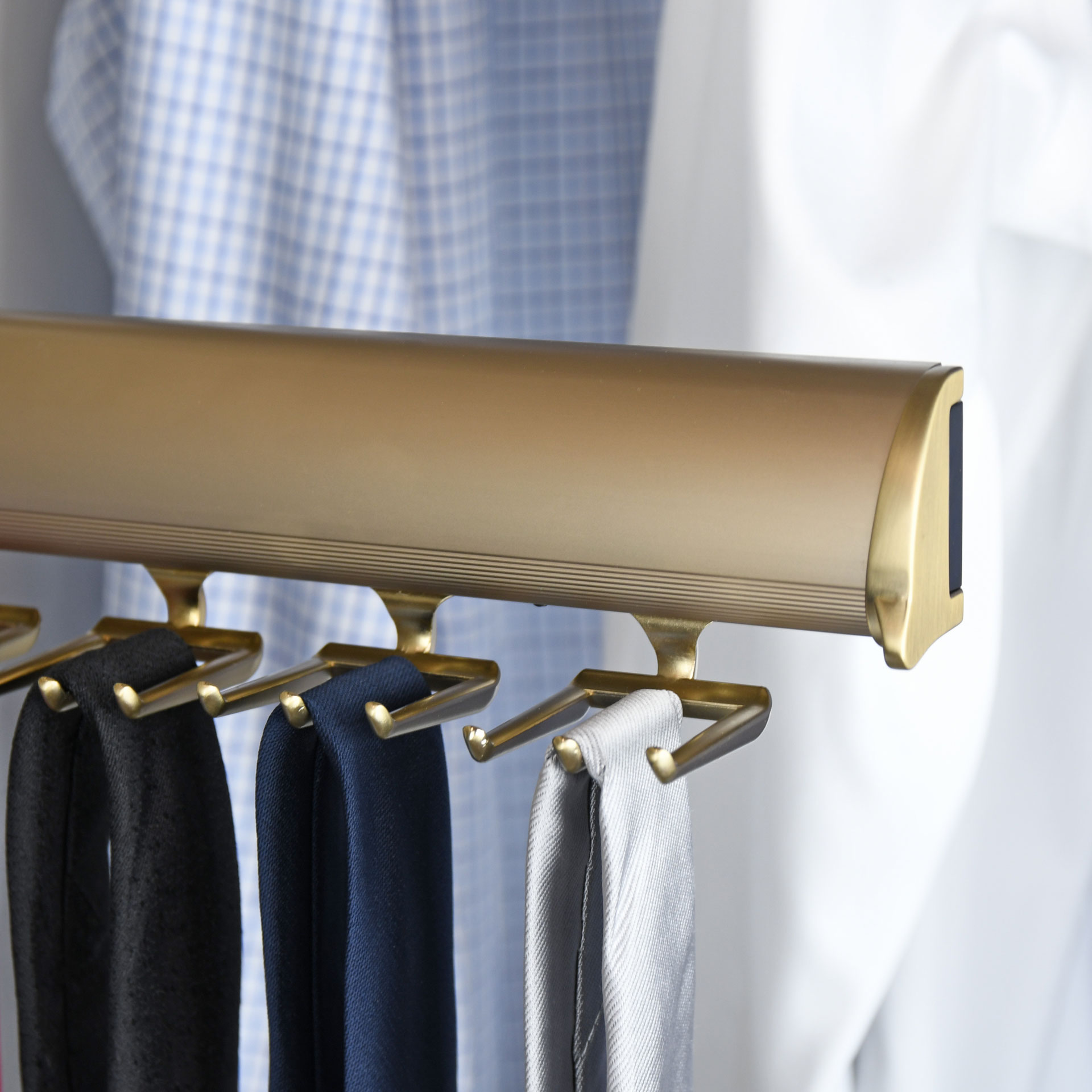
The benefit is access to space that would otherwise be inconvenient. The mechanism still needs room to move. Check hinge positions, panel depth and the space in front of the closet. Include the hanging accessories, which may extend beyond the hardware itself. Example: TAG Tie Rack – Full Extension ↗.
When does it make sense? When accessories need to sit inside the cabinetry but remain easy to reach when brought forwards.
Other hardware suppliers offer similar pull-out racks. Compare extension, dimensions and mounting requirements. On a fully exposed wall, a simpler fixed rack may be equally convenient.
IDEA 05
A combined organizer: different accessories in one place
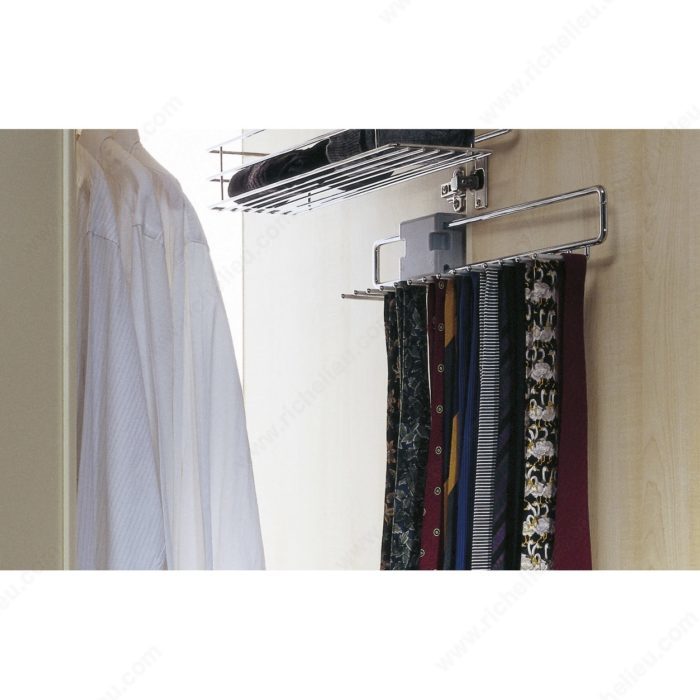
For a smaller collection, separate fittings for every accessory type may be unnecessary. A combined organizer provides one place for belts, ties and scarves.
The Richelieu 4963140 is one example. Its product information lists 14 hooks, dimensions of approximately 74 × 455 × 118 mm, and a required internal cabinet depth of 505 mm, or about 19⅞ inches. The distinction matters: the product’s own dimensions are not enough to establish whether it will fit the intended cabinet. Example: Richelieu 4963140 ↗.
Before buying, decide what will hang on it. A large buckle, a wide scarf and a narrow tie occupy different amounts of space. The number of hooks does not directly describe its comfortable capacity for your collection.
You can divide the organizer by use, keeping belts in one area and ties in another. If several bulky scarves obscure everything else, giving them a separate location may work better.
When does it make sense? When you have a small, mixed collection and prefer one mechanism to several separate fittings.
This is a representative example. Similar organizers may be available elsewhere; compare installation requirements and the actual space available for accessories.
IDEA 06
A divided drawer: simple organization or a designer finish
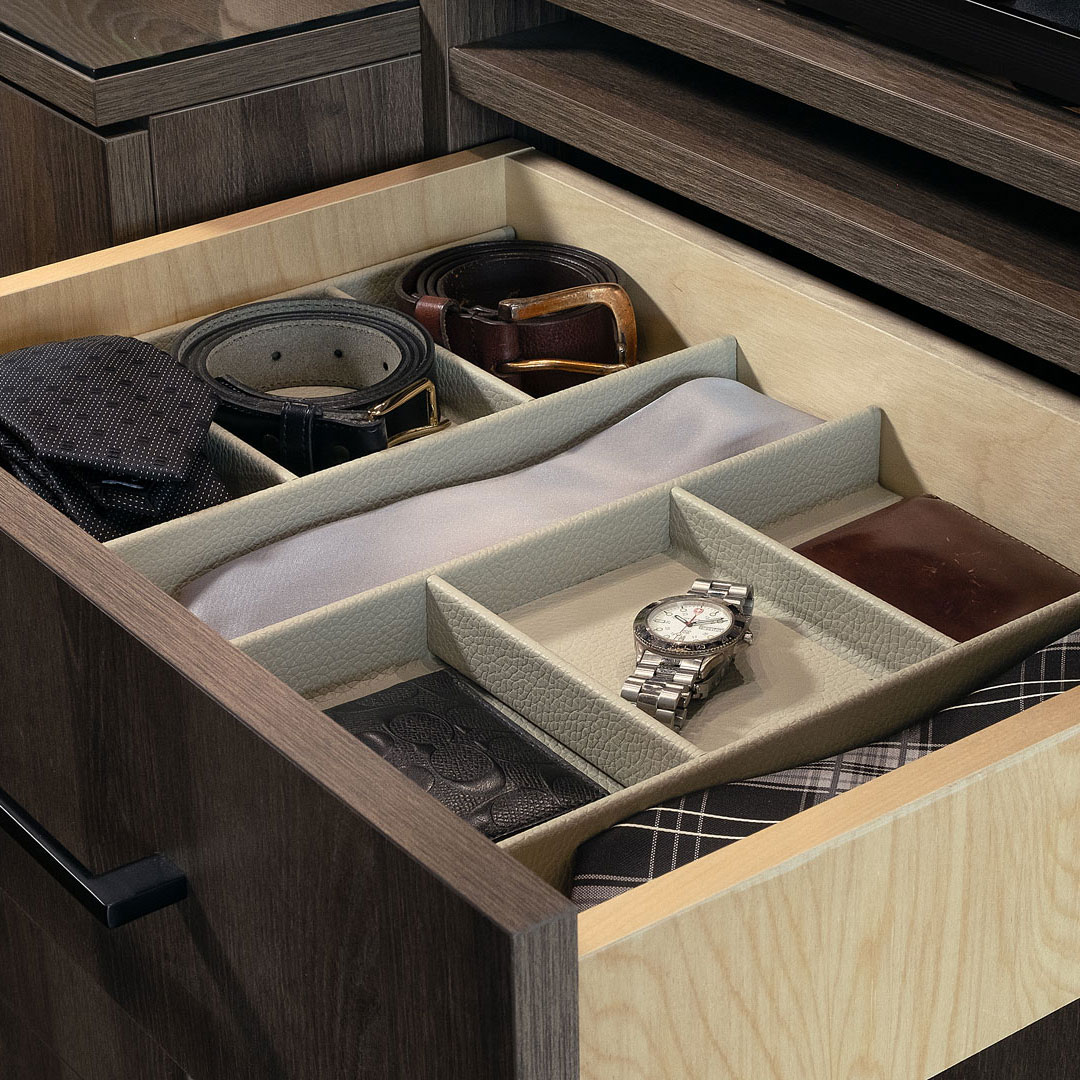
If you prefer to view accessories from above, a divided drawer is worth considering. Separate compartments give belts and ties their own places, making it easier to compare colors and patterns without searching through a pile.
You do not need a specialist system to begin. A few removable containers or simple dividers can help establish which arrangement suits your collection.
Compartment size matters most. A large buckle and a wide belt need more space than a thin tie. Choose a folding or rolling method appropriate to the accessory’s material and care instructions. Avoid forcing items into compartments that are too small.
A more design-focused example is the TAG Contour Tie & Belt Drawer Organizer. The system includes trays, compartments and a drawer-bottom liner finished in faux leather. The selected kit can be trimmed to fit as directed in its instructions. Compare its actual dimensions with the inside of the drawer before ordering. Example: TAG Contour ↗.
This is a more expensive approach than ordinary storage containers. When checked, one version at Pro Cabinet Supply was listed at $160.58. That price covered the organizer rather than a complete drawer and slides. The additional cost relates in part to its finish and fitted system. Example retail listing ↗.
For a taller drawer, the manufacturer offers an additional tray that slides above the organizer. This creates a second layer for small items, provided there is sufficient height for its movement and access to the contents below.
When does it make sense? When you like drawer storage and also value a carefully finished interior.
Simpler inserts from other brands can provide similar organization. A designer system is one option, rather than a requirement for keeping accessories tidy.
How to choose for your closet
| Your priority | An approach to consider | What to check |
|---|---|---|
| Organize without drilling | A hanger on the existing rod | Access between clothes |
| Use a small, empty surface | Individual hooks | Mounting and clear space below |
| See accessories immediately | A fixed rack | Spacing and accessibility |
| Store accessories behind clothes | A full-extension rack | Movement, hinges and space in front |
| Organize a small, mixed collection | A combined organizer | Support shapes and installation depth |
| View everything from above | A divided drawer | Compartment size and internal height |
Before choosing, take your accessories out of the closet. Count your belts, ties and scarves, identify those you wear most often, and see how much space they actually occupy. Then select the organizer.
You do not have to use one storage method for the entire collection. Everyday belts can hang on an accessible hook, ties can sit on a pull-out rack, and less frequently used accessories can stay in a drawer.
The greatest benefit comes from a solution that makes accessories easy to take out and put away. Saving space is useful when it also makes everyday access more convenient.
Examples and prices were checked on October 18, 2026. Descriptions are based on manufacturer and retailer information, rather than hands-on testing. Links illustrate particular solutions; similar products may be available from other suppliers. Check the current variant, price and installation instructions before ordering.