
Three manufacturer-backed directions to assess by practical value rather than treating them as universal design rules.
A review of examples, not a popularity ranking
This review looks at documented product directions from manufacturers. It does not claim that they are the most popular choices or report independent product testing. The useful question is what each direction could improve in a real home and what extra planning it brings.
The examples are concealed room functions, accessible pantry storage and coordinated decorative materials. They can be considered separately; a home does not need to adopt all three to feel coherent.
Concealed functions can change a shared room
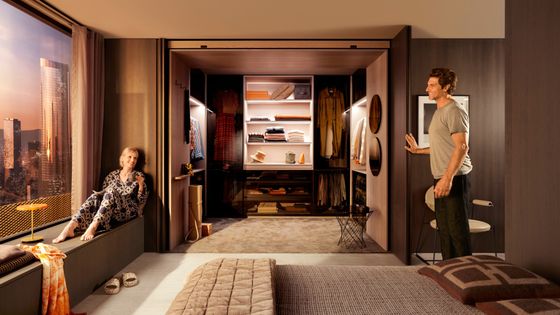
Blum REVEGO demonstrates a pocket-door approach to revealing and concealing furniture areas. Our inference is that this can help a room change visual character between activities when the working layout is carefully planned. The tradeoff is dedicated system space, construction detail and maintenance access.
Compare the complete open and closed arrangement with ordinary doors. Hiding a workstation or kitchen does not remove equipment ventilation, circulation or appliance requirements. The visual transformation is only one part of the decision.
Accessible storage is more useful than sheer capacity
Blum SPACE TOWER demonstrates individually accessible pantry levels. Our practical reading is that bringing a category forward can reduce the need to reach around a deep stack. Fixed shallow shelves and removable bins can sometimes solve the same problem with simpler furniture.
Choose the access method around the household’s contents and reach. A product demonstration does not establish that a mechanism fits a particular existing cabinet. Technical compatibility and useful loaded space remain part of the comparison.
Coordinated materials still need separate specifications
EGGER’s decorative material collections show coordinated colors and textures across product types. Our inference is that this can make a mixed furniture scheme easier to organize visually. It does not mean the matching products have identical cores or performance.
Use physical samples and select the correct product for each application. Treat a design direction as a prompt for a practical decision, not a requirement to buy a complete system. The strongest idea is the one whose benefit survives a check against the actual room.