
A smart pantry does not need to report every jar to an app. It needs to make the next missing ingredient obvious and let the household put groceries away without a new set of instructions.
This review starts with visible categories and removable storage, then considers fitted drawers and lighting only where they solve a remaining problem.

Make smart mean useful
A smarter pantry helps you know what is there and retrieve it with fewer steps. That may require no electronics at all. Start by identifying the repeated problem: missing ingredients, unreachable packets, duplicate purchases or poor lighting. Choose an improvement that addresses that problem directly.
Keep this separate from simply adding more shelves. A dense cabinet can store a lot while hiding the back row. Measure package sizes and review the amount kept in reserve before deciding how many compartments to add.
Give each level a clear job
Use a visible daily zone, a separate refill area and a destination for awkward packets. Individual internal pull-outs, such as the SPACE TOWER application illustrated by Blum, can bring a storage level toward the user. Fixed shallow shelves and removable bins may accomplish the same goal in a simpler cabinet.
Compare the loaded access, not just the empty mechanism. Check whether the door clears the pull-outs and whether you can identify contents without bending around the front. Avoid adding an organizer that creates a second hidden layer behind it.
Use lists only if someone will maintain them
A shared shopping list can prevent duplicate purchases when it reflects the way the household shops. Begin with a short list of staples rather than a detailed inventory that becomes out of date after every meal. Keep the list easy to update at the point where a package runs out.
Connected storage or weighing ideas need a clear benefit and a maintenance plan. Consider batteries, connectivity, cleaning and what happens when the service is unavailable. A label and visible refill bin may be more dependable for an ordinary household.
Add light and automation selectively
Task lighting can help in a deep cabinet, provided the fitting, cables and controls suit the furniture. Position the light so stocked shelves do not block it. Check power and service access before adding strips around moving parts.
Trial the organization first and review it after a grocery cycle. Buy technology only for the problem that remains. A useful pantry is easy for everyone in the household to understand and put back in order.
Start with a movable category, then decide on hardware
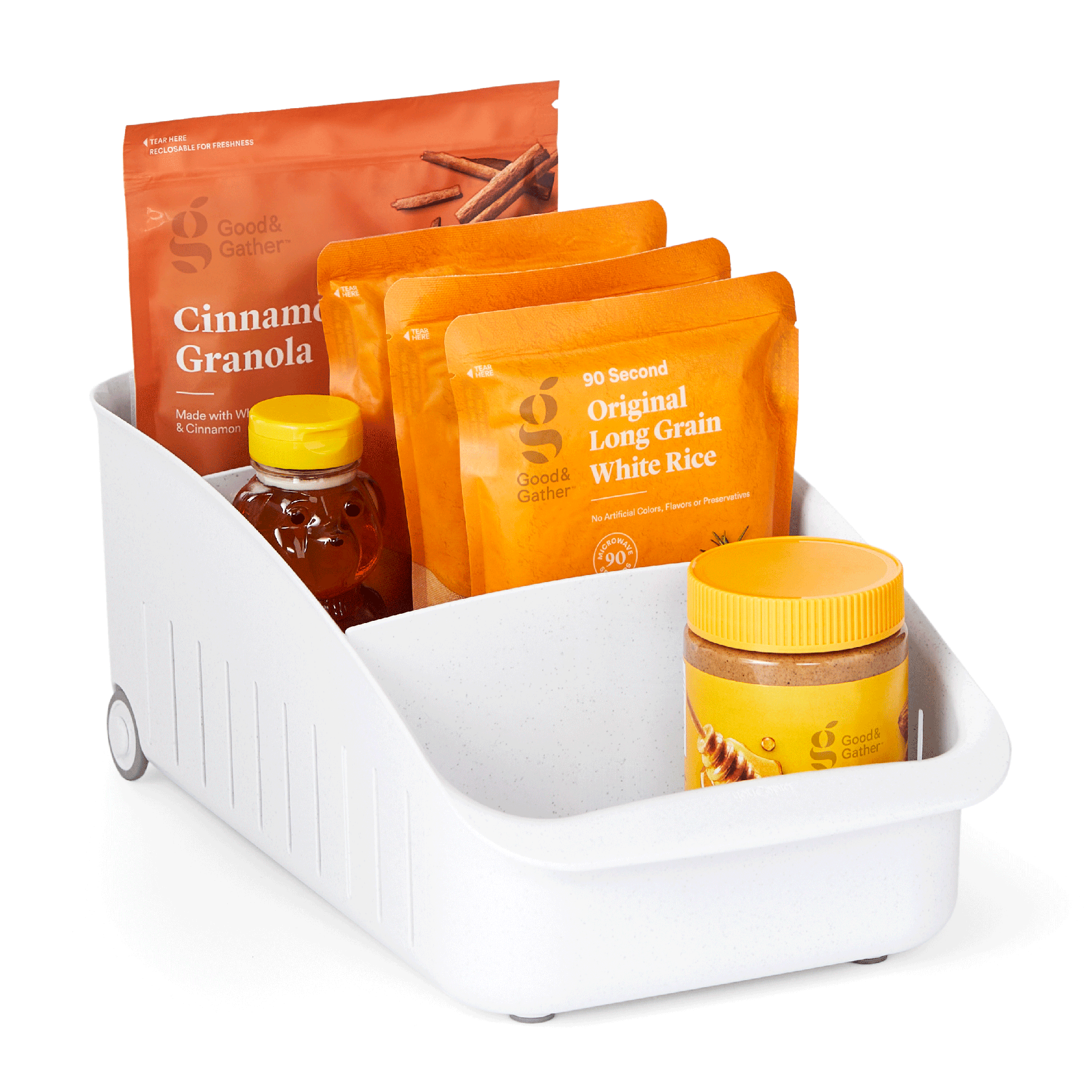
The YouCopia RollOut pantry bin ↗ groups a category behind handles and dividers so it can move forward on an existing shelf. It shows what a small organizational change can do before a cabinet rebuild. Check its loaded handling and the shelf edge; wheels do not turn it into a full-extension fitted drawer.
For a whole pantry redesign, Blum SPACE TOWER ↗ offers individually opening internal storage levels. Its additional cost is tied to drawers and cabinet hardware, while an ordinary bin relies on lifting or rolling across the shelf. Choose according to the troublesome level rather than fitting every shelf identically. A visible refill zone may prevent more duplicate purchases than a detailed inventory nobody updates.
The linked products are examples of different approaches. Similar solutions can be found from other manufacturers and stores. Compare the exact model, supplied components and installation requirements. Product photographs are credited to their source. This article describes functions and planning considerations, rather than a hands-on test.