
A hamper that fits its recess can still be frustrating if the full bag cannot be lifted out. Laundry storage should follow the whole route from the bathroom to the washer.
We compare a divided freestanding basket, removable bags and fitted laundry storage, including the space needed to empty and clean them.
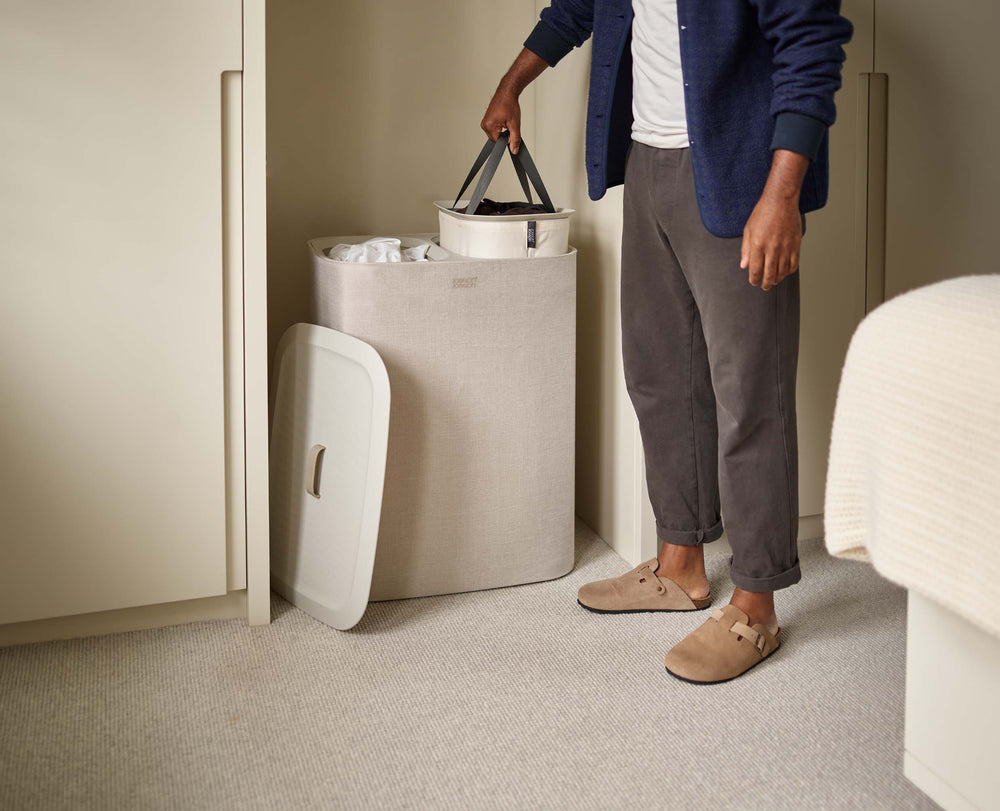
A freestanding basket with removable bags
This is a straightforward option for a finished bathroom. Its position can change without altering cabinetry, while a removable bag reduces the need to carry the whole structure.
Joseph Joseph Tota is an example of a divided basket family with removable bags. Capacities and compartment counts vary, so compare the exact model. Check how the lid is removed and whether a bag can be lifted out beneath any shelf above.
A pull-out behind a front
A built-in hamper creates a calmer view of the bathroom. It must still project into the room when opened, and the container or bag needs clearance for removal. A narrow unit beside the toilet may not provide that travel.
Rev-A-Shelf offers bathroom storage and organization equipment; select any hamper against its specific mounting requirements and permitted environment. A basket intended for a dry closet should not automatically be treated as suitable for exposure to water.
Check load rating, attachments and access for cleaning the cabinet bottom. The bag or container should also have clear care instructions.
A tilt-out front needs space inside
A basket behind a tilting front may occupy less passage space than a full pull-out. Its movement also takes place inside the cabinet, where the shelf above and container shape limit capacity and access.
Check whether the bag can be removed comfortably, not simply whether socks are easy to drop in. In a custom arrangement, the mechanism must suit the front and full hamper load. An arbitrary hinge is not a substitute.
Two compartments depend on household habits
Separate areas for different laundry groups can reduce sorting beside the washer. The division needs to be clear. Two small bags that constantly overflow will not be more convenient than one larger basket.
Not all laundry has to stay in the bathroom. Where space is limited, a small container can collect items from this room while the main hamper lives in a laundry room or another suitable location.
Damp items need separate attention
A laundry basket should not replace a place for a wet towel to dry. Leaving damp textiles in a closed bag for a long time encourages unpleasant odors. Allow them to dry before storage, in a way appropriate for the fabric.
Holes in a container do not guarantee effective ventilation throughout a cabinet. Avoid positioning the hamper where shower water regularly reaches it.
The simpler option can be the most practical
A light basket or bag in a stable frame may be enough. When comparing Amazon listings, look beyond liters to handle design, bag-washing instructions and replacement-part availability.
Before choosing, picture the full basket and the route to the washer. If it has to squeeze past doors, be lifted over the basin or have its contents tipped out first, change the arrangement even if that means a little less capacity.
Which matters more to you: a hidden hamper or moving the laundry in one easy trip?
Compare carrying the bag with carrying the furniture
Joseph Joseph Tota Twin 90L ↗ is a freestanding example with two removable bags. Its useful distinction is taking the laundry out in the bag rather than carrying the whole basket. Check access above it, washing instructions and whether the two compartments suit actual laundry habits.
TAG Curate ↗ illustrates the cabinet-integrated direction. It can make the furniture appearance more consistent, but adds a compatible frame, front and removal clearances to the project. That is a design and installation upgrade, not a requirement for basic sorting. Keep any chosen hamper outside regular splash exposure and give damp textiles a separate drying route.
The linked products are examples of different approaches. Similar solutions can be found from other manufacturers and stores. Compare the exact model, supplied components and installation requirements. Product photographs are credited to their source. This article describes functions and planning considerations, rather than a hands-on test.