
Bathroom furniture is exposed at its edges, holes and joints as well as on its visible face. Choosing a familiar color or a moisture-resistant label is only part of the material decision.
We compare decorative boards and other finished fronts through their complete construction, care and repair options, using manufacturer ranges as examples rather than guarantees for every bathroom location.
Consider the whole construction
Bathroom furniture faces splashes, changing humidity and regular cleaning. Assess the complete construction: panel core, finish, edges, cutouts, hardware and joints. A durable-looking face does not reveal how an unfinished edge or fixing hole will respond to moisture.
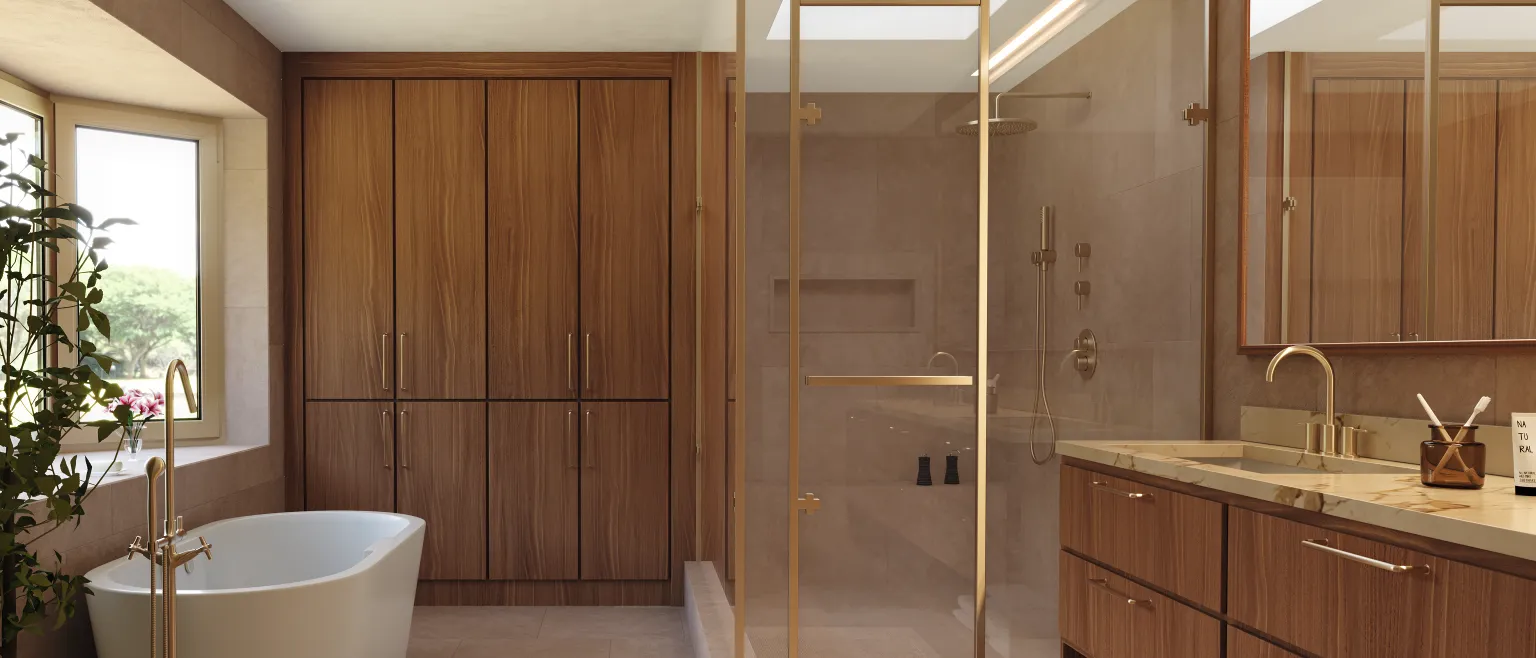
Choose furniture explicitly intended for the location and follow its installation instructions. Do not assume a kitchen or bedroom panel can be placed in a splash zone simply because it has a similar decorative surface. The manufacturer setting illustrates decorative surfaces, not an exposed sample proving the core of every component.
Separate moisture resistance from waterproofing
Moisture-resistant board grades and bathroom-suitable surfaces have product-specific conditions. They are not a reason to leave water standing on furniture or omit the prescribed sealing and ventilation. Ask the supplier which grade is being supplied and how vulnerable details are protected.
EGGER’s bathroom materials information is a useful manufacturer reference for coordinated surfaces and applications. Confirm suitability for the specific panel and installation. A decorative match across materials does not mean that every matching board has the same performance.
Compare maintenance and repair
Painted, laminated, veneered and other finished fronts have different cleaning and repair requirements. Review the exact care instructions. Test samples under the bathroom lighting and consider marks around handles, textured surfaces and the visibility of small edge damage.
Ask how a damaged front or panel could be replaced. Removable shelves and accessible hardware can make future maintenance easier. Keep the material code and finish reference rather than relying on a color name that may describe several products.
Specify the details before ordering
Show basin cutouts, pipe penetrations, wall fixings and contact with floors on the drawing. Confirm the prescribed treatment for those details and access for service. The installer should not have to invent the edge protection after the furniture arrives.
Compare complete installed options, including fixings and finishing work. A sensible material choice fits the moisture conditions, cleaning routine and construction details of the actual bathroom.
Separate a coordinated decor from a technical specification
EGGER Bath Solutions ↗ shows coordinated decorative surfaces, including matt and woodgrain appearances. The practical benefit is matching the visual scheme across selected components. It does not mean every board sharing the same decor has the same core, edge treatment or exposure limits.
Ask for the exact panel grade, thickness, surface and edging in the quotation. Compare a finished sample with a painted or veneered alternative, including cutouts and replacement arrangements. A premium surface may improve touch, appearance or care, but extra cost cannot compensate for an unfinished cut edge beside a wet basin. Keep the product codes and care instructions with the installation record.
The linked products are examples of different approaches. Similar solutions can be found from other manufacturers and stores. Compare the exact model, supplied components and installation requirements. Product photographs are credited to their source. This article describes functions and planning considerations, rather than a hands-on test.