
Cutlery trays are familiar, but many drawers still become a tangle of long utensils and small gadgets. A useful organizer saves effort when putting things away as well as taking them out.
This review compares a simple flat tray with tiered compartments, modular divisions and a sliding upper layer, so you can decide which approach uses your particular drawer most comfortably.
One drawer does not have to do everything
Table cutlery, cooking utensils and occasional gadgets have different jobs. Everyday forks and spoons belong where setting the table and unloading the dishwasher feel natural. Tongs and spatulas should be close to cooking.
This does not require three separate drawers. Distinct areas within one can work in a small kitchen. Moving rarely used gadgets elsewhere can still free the most convenient space for everyday tools.
A flat tray: everything visible at once
A conventional tray lays cutlery side by side. Its layout is easy to understand, but the compartments must match the items. A short compartment leaves table knives lying diagonally and taking over the neighboring space.
Before buying, lay out your longest spatula, ladle and whisk. Measure the drawer inside at the bottom and higher up: sloping sides may restrict a wide insert. The front width is not the usable internal width.
Modules: a layout you can change
Systems such as Blum AMBIA-LINE provide components for organizing drawer interiors. They can create utensil areas without a custom divider for every object. Choose components suitable for the particular drawer and intended use.
Leave a longer space for tools that do not fit small compartments. Check whether modules stay in place during opening and can be lifted out for cleaning. An attractive arrangement in a photo does not show how your own collection will fit.
Richelieu Separado ↗ offers another fitted-divider approach. Compare how the layout accommodates a ladle or a whisk rather than counting small rectangular compartments. A bespoke-looking interior still needs enough free length for tools whose shape changes from one collection to another.
For an existing drawer, try removable shallow trays before specifying a full matching system. Leave a clear grip around the longest item. Paying more for coordinated components is worthwhile when they stay stable and suit the drawer construction, rather than merely making the empty drawer look uniform.
A tiered insert saves width but needs clearance
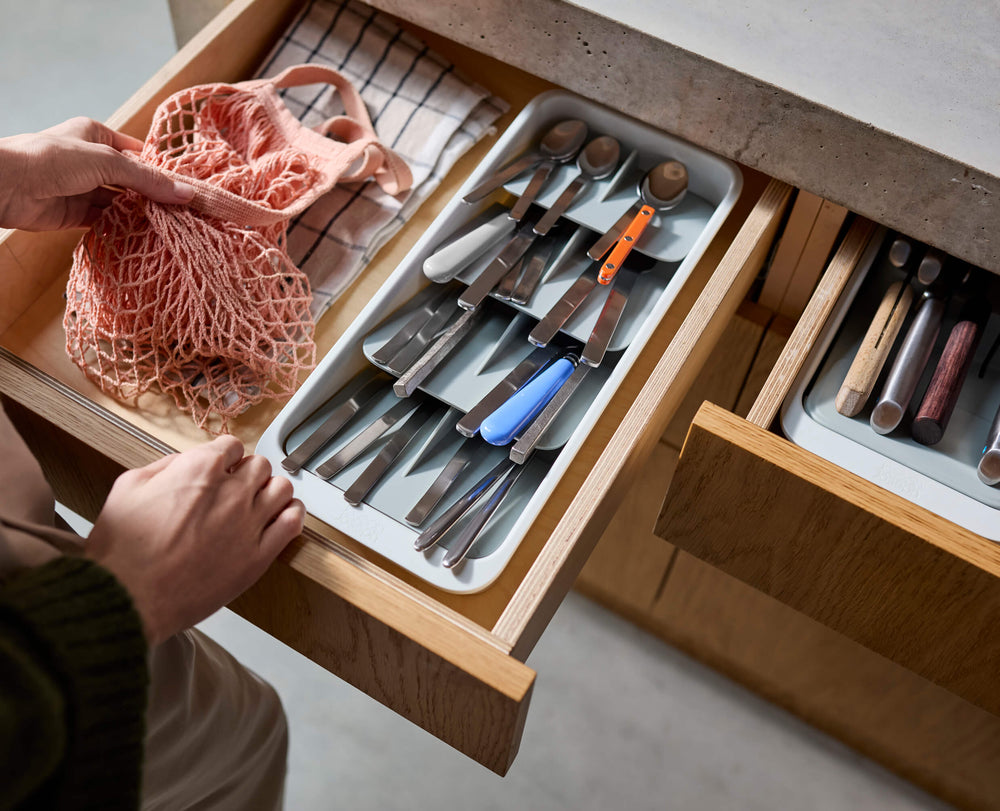
Joseph Joseph DrawerStore Large Tiered overlaps some compartments. It is an example for a narrow drawer where a flat tray would consume too much surface area. The manufacturer also provides for disassembly for cleaning.
Free height matters, including the cutlery placed inside. Overlapping layers may also make a quick visual inventory less immediate than with a flat tray. The choice depends on whether width or an unobstructed view matters more.
A lower-cost change: a few separate trays
A complete system is not always necessary. Several shallow containers or a correctly sized ready-made tray can organize an existing drawer without altering the cabinet. Simple organizers can also be found on Amazon; compare usable dimensions, materials and cleaning requirements rather than compartment count alone.
An expanding insert is convenient only if it stays stable. A pressure-fit divider should not distort the drawer sides. A mat underneath may reduce sliding, but it cannot fix a poorly fitting organizer.
Use spare height with a sliding upper tray
YouCopia DrawerFit ↗ illustrates a removable upper storage layer that slides to reveal what is underneath. This can separate small accessories from larger utensils in a deeper drawer without changing the cabinet itself.
The upper layer needs support at the right width and enough headroom for loaded contents. It also needs somewhere to move. A second layer that covers the only space available to reach the whisk can make a full drawer less convenient, despite increasing its nominal capacity.
Try the layout before buying
Cut a cardboard outline and mark the proposed compartments. Lay your utensils on it and check that you can comfortably grip each one. Leave some room for change: a drawer fitted perfectly to today’s collection can become awkward after one larger tool is added.
What most often disrupts your drawer: long utensils, small compartments, or too many gadgets?
The linked products are examples of different approaches. Similar solutions can be found from other manufacturers and stores. Compare the exact model, supplied components and installation requirements. Product photographs are credited to their source. This article describes functions and planning considerations, rather than a hands-on test.