
A kitchen corner is easy to fill and surprisingly difficult to empty. Ordinary shelves are the obvious starting point, but reaching the pot at the back can mean moving several others first.
Specialist mechanisms offer comfort through different movements: rotating, swinging out or bringing baskets forward in stages. Here we compare those approaches with simpler storage, so you can choose for your cookware, cabinet and budget.

First, identify the type of corner
An L-shaped cabinet accessed through appropriately arranged doors differs from a blind-corner cabinet whose hidden section extends behind the adjoining run. In the latter, the contents must pass through an opening on only one side.
That distinction determines the mechanism. A carousel designed for one cabinet is not automatically a substitute for a blind-corner system. Door width alone is insufficient: internal dimensions and mounting positions matter.
In an existing kitchen, also check hinges, fixed partitions, services and whether the mechanism can pass through the opening during installation. Retrofitting may be possible without replacing the furniture, but not every system suits every existing cabinet.
1. Rotating shelves: bring the contents to the opening
The shelves rotate around an axis, bringing an item closer to the cabinet opening. You need not remove the front pots merely to reach those behind them.
Examples include Lazy Susan systems from Rev-A-Shelf and Kesseböhmer. Shelf shape, support arrangement and interaction with the front differ between constructions. “Carousel” does not describe a single standard.
For large cookware, check shelf diameter and space for handles. Check item height too: tall objects must clear the rotating level above and remain within the intended movement area.
A carousel can reduce the need to move cookware around when the opening lets you grasp it comfortably. It does not remove the need to bend down to the lower shelf.
Rev-A-Shelf kidney-shaped shelves ↗ · Kesseböhmer Lazy Susan ↗
2. LeMans: the shelf comes out in front
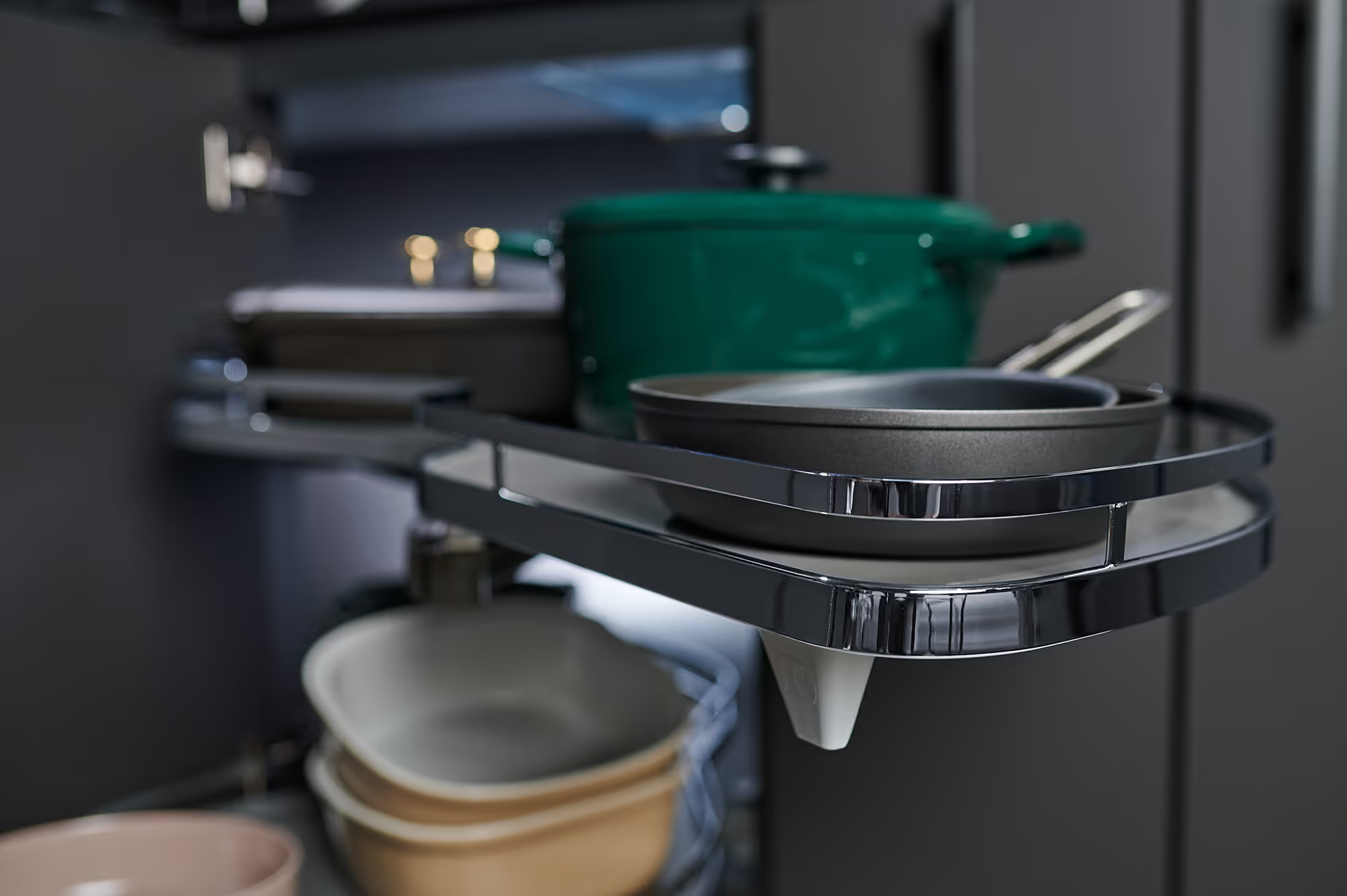
Kesseböhmer’s LeMans II has distinctively curved shelves. Its mechanism guides them out of the blind corner through the cabinet opening. The shelves move independently, so you do not need to operate both levels when you want only one item.
The advantage is seeing and grasping contents closer to you. The curved shelf does not match the rectangular cabinet floor, however, and the mechanism occupies room. Test the arrangement of your own cookware rather than comparing only the volume of an empty cabinet.
The manufacturer offers different shelf sizes and variants. Its US page also describes optional closing assistance, so do not assume every set includes the feature without checking the product number.
Handing, clear opening, height and the shelf’s path in front of the cabinet all matter. An adjacent handle, dishwasher front or projecting appliance housing can restrict movement.
3. Front and rear baskets: access in stages
Another blind-corner approach moves sets of baskets. The front section comes out or shifts aside, allowing access to the rear section.
Kesseböhmer’s MagicCorner I is a door-linked example: opening the front starts the movement of the front section and brings the rear section forward. That describes a particular version, not every product sold under a “magic corner” label.
Rev-A-Shelf’s 5PSP Blind Corner Optimizer is another system intended for blind corners. Compare the sequence of movements and where the rear section ends up. Two systems in similar photographs may require different operation.
Rectangular baskets can help group cookware and containers, but have defined dimensions and load limits. A pan with a long handle may fit on the basket surface yet obstruct its movement past the frame.
Watch the manufacturer’s video and follow the complete opening and closing path. Consider access for cleaning and retrieving an item that falls below the baskets too.
4. Corner drawers: a different cabinet design
A corner can also be planned as a stack of drawers. Blum’s SPACE CORNER is an example whose front arrangement allows the drawer to open without colliding with adjacent fronts.
This is primarily a cabinet-design decision, not a simple insert for an arbitrary existing corner. It requires the appropriate cabinet geometry, fronts and runners.
A drawer lets you see the contents from above and organize them with dividers. Its unusual shape still needs testing against your own objects. A large pan will not necessarily use it as effectively as several smaller containers.
5. A plain shelf may be enough
If the corner holds a large pot used only a few times a year, daily pull-out convenience may not justify the cost. A fixed shelf remains reasonable when you know what is there and accept the more difficult reach.
Keep the number of items manageable and group them. A removable container can bring several small objects forward if it fits through the opening and is not too heavy. It does not automatically recover the entire blind section.
A small rotating tray for accessories is not a substitute for a cookware carousel either. It can organize part of a shelf when its capacity, diameter and reach suit the task.
YouCopia SmoothSpin ↗ illustrates the smaller, removable turntable category. It can organize jars or packets within reach on a shelf, but it is not a replacement for a load-rated cookware carousel. Its complete loaded circle still needs to pass the door and clear adjacent contents.
This is the simpler option when the problem is a few small items disappearing behind one another. For large pans in a blind cabinet, the guided movement of a fitted system addresses a different task. Compare the retrieved item and the space needed to use it, rather than treating every rotating product as the same solution.
6. Leaving part of the corner unused is also a choice
In a new kitchen, compare a fitted corner with a layout that closes off part of the corner and provides convenient drawers beside it. Some volume is lost, but organization and access to everyday items may improve.
There is no universal winner. Accessible extra storage may be precious in a small kitchen; elsewhere an expensive mechanism may become a complicated home for things rarely used.
Compare the adjoining cabinets as a whole, not only the corner. Useful storage and comfortable meal preparation matter more than filling the entire cabinet volume.
What to measure before buying
Measure the clear opening after accounting for hinges, internal width and depth, available height, opening direction and space in front. Add the dimensions of your largest cookware, including handles and lids.
Check loads for the exact mechanism and level rather than borrowing a rating from a similar picture. A heavy cast-iron pot may change how you distribute the contents.
The best test is the full sequence: open, remove the item used most often, replace it and close. If you have to move something nearby at every stage, the corner still is not working as it should.
Is your kitchen corner useful storage, or the place where pots disappear?
The linked products are examples of different approaches. Similar solutions can be found from other manufacturers and stores. Compare the exact model, supplied components and installation requirements. Product photographs are credited to their source. This article describes functions and planning considerations, rather than a hands-on test.