
A knife needs a defined storage position where its handle is easy to grasp and its edge does not meet other tools. A block is familiar, but it is only one way to organize a collection.
This article compares drawer inserts, magnetic storage, guards and specialist pull-outs, focusing on the movement and space each approach needs rather than assuming one construction suits every kitchen.
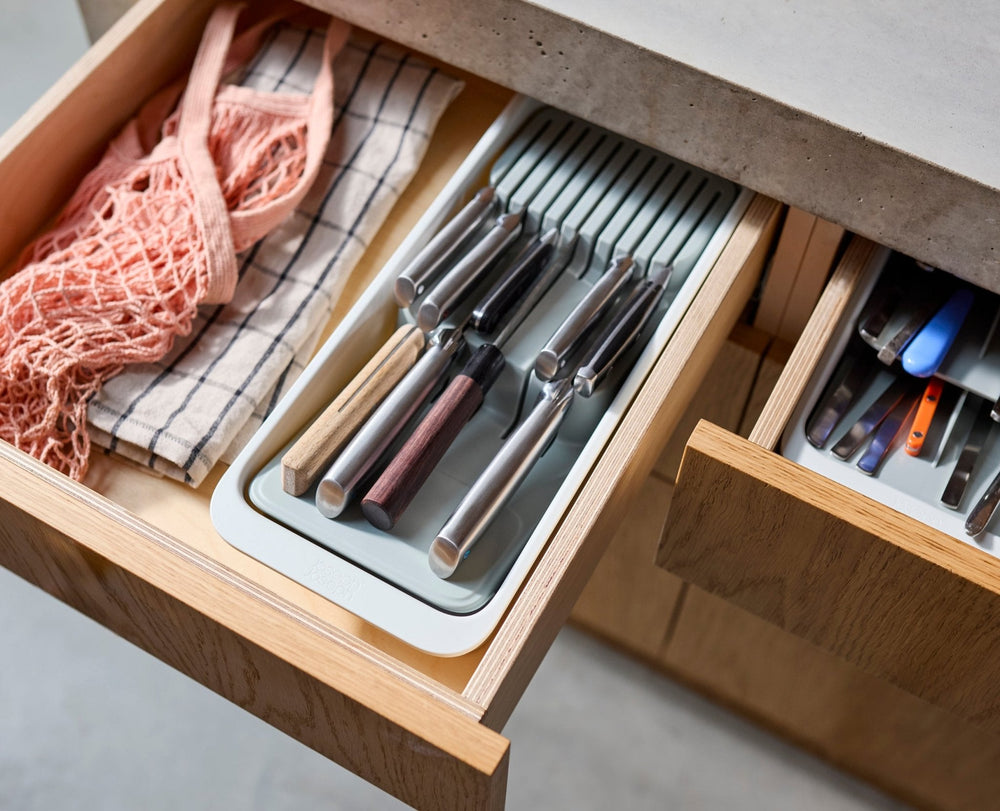
A drawer insert: clear counter, defined positions
An insert with individual slots keeps knives in defined positions. Handles are visible, so you can pick one without searching through the contents. Examples include the Blum AMBIA-LINE knife holder and Joseph Joseph’s tiered DrawerStore.
Capacity is not just the number of slots. Check blade length, chef’s-knife width, handle thickness and the height of the loaded arrangement. A broad cleaver or strongly curved handle may not fit an insert that holds several narrow knives.
The current DrawerStore product page gives conflicting drawer-height requirements in two sections. Confirm the clearance for the specific item before ordering. Do not transfer the capacity of an older version to a newer one just because their names are similar.
A separate horizontal block instead of a complete system
An existing kitchen may need only a freestanding wood, bamboo or plastic insert, rather than a replacement drawer. Such products are also sold on Amazon. Look for a cross-section or slot description showing how the edge is covered and whether the knife can be lifted out freely.
The insert should remain stable and be removable for cleaning. A tightly fitted organizer that cannot be lifted without dismantling the drawer makes crumbs harder to remove. Put knives away clean and dry, following their manufacturer’s instructions.
Richelieu Separado drawer organization ↗ is another reference when specifying the surrounding utensil layout. Keep the knives in an appropriate dedicated holder rather than assuming ordinary divider compartments protect their edges. The rest of the drawer can remain modular instead of being rebuilt around one set of knives.
A magnetic strip: visible and quick to reach
A strip near the preparation area can free counter and drawer space. Every knife is visible, but the blades remain exposed. In a home with children, assess access carefully; mounting height alone is not a safeguard.
Check the strip’s intended use, attachments and compatibility with blade materials. A ceramic knife will not be held magnetically like a compatible steel blade. Heavy or unusually shaped knives also need confirmation of suitability.
Choose a location that lets you place and remove a knife calmly without reaching over a hot cooktop. A strip right beside the sink may be repeatedly splashed.
A countertop block: no cabinet alteration
A standing block is easy to position and move. It does use work surface, and a fixed slot arrangement may not suit knives purchased individually.
Check cleanability, base stability and room to withdraw the longest knife. A block tucked beneath a low wall cabinet may look tidy but need moving every time it is used.
Blade guards: an option for a small collection
With only two or three knives, correctly fitting guards may be simpler than a large block. Each must match the blade and remain attached during storage. Keep guarded knives in a defined drawer area rather than mixing them among utensils.
Organizing is separate from restricting access
An insert organizes knives but does not lock the drawer. Where young children live or visit, choose an appropriate additional safeguard for the storage location. That decision is separate from the organizer’s material or color.
The final check is straightforward: can each knife be removed and returned by its handle without touching a neighboring edge? If several others must be rearranged, the layout needs changing.
Which arrangement works best for you: a drawer, a block or a magnetic strip?
A dedicated pull-out for a larger collection
Rev-A-Shelf 449KB ↗ illustrates a cabinet pull-out organized around knives and utensils. This makes a different investment from placing a small block in an existing drawer: a dedicated bay, moving frame and suitable mounting become part of the purchase.
Its benefit is a defined selection area beside preparation. Compare that with a removable drawer insert when only a few knives are involved. Check the exact blade accommodation, cleaning access and position of the handles; an expensive mechanism does not compensate for a poor location.
The linked products are examples of different approaches. Similar solutions can be found from other manufacturers and stores. Compare the exact model, supplied components and installation requirements. Product photographs are credited to their source. This article describes functions and planning considerations, rather than a hands-on test.