
A closet mirror earns its place when you can see a complete outfit without moving a chair, opening another door or standing in the only route through the room. Choose the viewing position first; the mirror itself comes second.
Start with the standing position
Mark where you naturally stand after getting dressed. From that spot, check the reflection using an existing mirror before choosing a larger one. The useful view depends on mirror height, its position and your distance from it. A tall panel hidden behind a door may be less convenient than a simpler wall mirror with a clear place to stand.
Include another person using the room in the check. A mirror at the end of a narrow passage can create a conflict between getting dressed and reaching the wardrobe. Keep the route understandable, especially where drawers or hinged doors open into the same area.
A wall mirror is the straightforward starting point
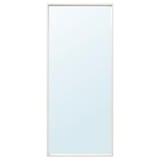
A framed wall mirror keeps the wardrobe construction separate from the reflective surface. IKEA NISSEDAL is a product example: the selected page shows a rectangular framed mirror. Use its current mounting instructions and the correct fixings for the wall. Its appearance does not make it suitable for attachment to a moving wardrobe door.
A freestanding mirror is another option when the product is specifically designed for that use. Do not turn an ordinary wall-mounted model into a leaning mirror simply because it looks stable in a photograph. Choose the intended installation rather than improvising around the frame.
Mirrored doors and concealed fittings need more planning
A mirrored wardrobe door combines storage access and outfit checking, but its position changes whenever the door moves. Check the reflection with the door in its normal position and consider handles, adjacent doors and the room behind you. Use a door system specified for the mirror and its weight.
A pull-out mirror can keep the outside of the wardrobe quieter. It also occupies usable space and needs a clear travel path. Ask for the actual fitting drawing, mounting requirements and fully extended position. A sliding mirror and a pivoting mirror are different mechanisms; the name alone does not establish how either will work in your bay.
Light the person as well as the cabinet
A bright fitting directly behind you can leave your face and clothes in shadow. Try the proposed mirror position in the light you normally use in the morning and evening. Look for distracting glare and check whether opening a wardrobe door blocks the light.
For a small budget, begin with a properly installed wall mirror and an uncluttered standing area. For a renovation, plan the mirror, lighting and door movement together. Spend on the mechanism only when concealing or moving the mirror solves a real space problem.
Before you buy
- Clear standing and circulation space
- Fixings suitable for the selected wall or door system
- A useful reflection in everyday lighting
- Full travel and service access for a moving fitting
Sources and product notes
Product information reviewed on October 17, 2026. Original product information and photo source ↗. Product availability, components and specifications can change. Layout comparisons are editorial guidance, not a report of a hands-on product test.