
Give a compact shed a clear route, visible categories and a practical place for long equipment.
Measure the opening and the working route
Begin with the door opening and the route to the farthest stored item. Include the space needed to turn with a long tool or carry a loaded box. A shed filled from wall to wall may have plenty of storage and very little usable access.
List the largest equipment first, then group hand tools, pots and seasonal supplies around it. Keep the items used most often near a convenient opening rather than behind occasional machinery.
Use the walls selectively
Suitable rails, racks and shelves can clear floor space, but their installation must match the shed construction. A thin wall panel may not support a load simply because a fixing can pass through it. Follow the storage and shed manufacturers’ requirements.
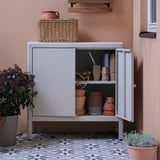
The KOLBJÖRN cabinet image illustrates a small outdoor storage alternative, not the interior of a completed shed. A cabinet can be enough when the main need is a modest group of tools rather than a full building.
Keep small supplies visible
Use shallow labeled groups and containers that can be carried to a task. Avoid a deep unmarked box of mixed fittings and accessories. Keep product identification and storage instructions with supplies that require them.
Do not assume the shed is suitable for every chemical, fuel, battery or powered device. Choose storage from the product requirements and local conditions. Ordinary shelving is not a substitute for specialized or secured storage where required.
Leave room for cleaning and change
Keep the floor and door movement accessible. Put tools away according to their care instructions and inspect the building for water entry or other problems. A tidy layout should make those checks easier, not hide the surfaces.
Try a simple arrangement before fitting every wall. Review the return routine after normal gardening and leave a little spare room for changing equipment. A useful shed is one in which the next item can be found without unpacking the previous season.