
Fold them, drape them over a bar or hang them at full length: each way of storing pants uses space differently. The useful question is how easily you can take out the pair you want.
Specialist fittings can make dressing more comfortable and use the available space more effectively. In this article we compare several approaches, from ordinary hangers to sliding and pivoting racks, so you can judge which movement suits your clothes, closet and budget.
1. Pull-out frames: bring the collection into view
Pants are draped over parallel arms held in a frame. Slides bring that frame forward, making it easier to see each pair and reach those at the back.
Built-in systems are the more involved option: slides, a frame and purpose-made hanging arms must all fit the available opening. The benefit is seeing the collection at once; the trade-off is dedicating a complete bay to this task. Compare the complete installed package, including its supports, rather than just the price of an insert.
Rev-A-Shelf’s Elite PSCSL combines full-extension, soft-close slides with individually hinged steel arms featuring a non-slip surface. Moving an individual arm and sliding the entire frame are separate functions. When comparing products, check whether the exact model offers both.
A frame provides an orderly overview, but needs a dedicated cabinet zone and space in front. If there is too little room below the arms, the pant legs will rest on a shelf or drawer even when the hardware itself is correctly installed.
2. A compact sliding rack for a few pairs
Not every collection needs a full-width frame. A smaller sliding rack can give frequently worn pants a convenient home while leaving the rest of the closet for other clothing.
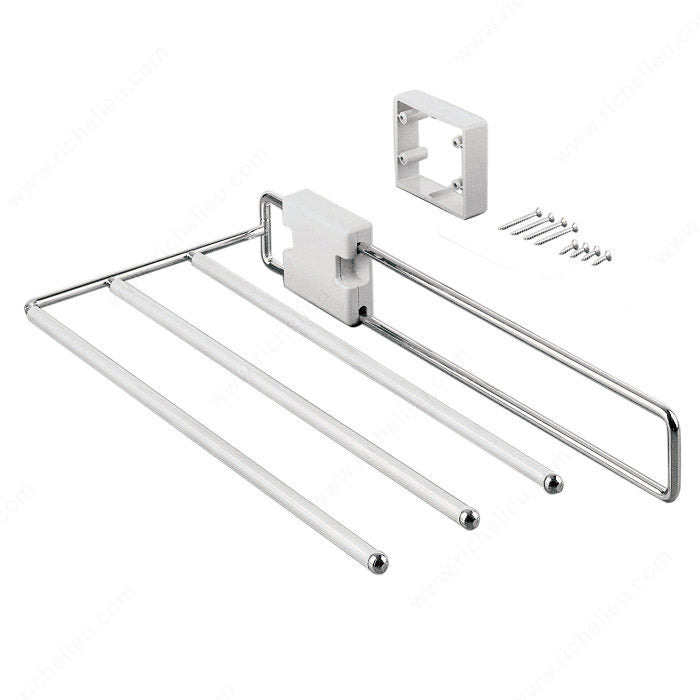
Richelieu’s 4961140 has three arms with non-slip sleeves. The distributor gives overall dimensions of 222 × 455 × 72 mm and describes a front handle for pulling the rack toward you.
Consider this approach when you want an accessible place for work pants without a large bank of hanging positions. Before ordering, check the mounting instructions, required cabinet opening and access with the doors open. Product dimensions do not replace installation clearances.
A non-slip surface helps retain fabric, but does not mean each arm should hold several heavy pairs. Follow the specific model’s capacity and load guidance.
3. Fan racks: access by pivoting sideways
This movement is different from a frame travelling on slides. Individual arms pivot around a side mounting, allowing you to spread the hanging pants apart.
Rev-A-Shelf’s Wire Fan Pant Rack CPRF is a real example. The manufacturer describes left- or right-side mounting and storage for nine pairs. Check the complete instructions and exact variant before ordering; the mounting footprint and the space swept by the loaded arms are different measurements.
The important clearance is the space swept by the arms. They should not hit a neighboring partition, hinges or clothing. A bracket fitting on the side panel is not enough to establish that the rack will be convenient.
A fan rack can be an interesting alternative to a sliding frame, but compare it when loaded. Pants have thickness, and adjacent pairs should not block the movement.
4. A regular clothes rail and individual hangers
The simplest arrangement has a useful advantage: you can remove the hanger with the pants, carry it elsewhere and put it back in a different position. Pants worn with a particular jacket can stay together on a suit hanger.
Draping pants over a bar reduces the height required, but introduces a fold. The bar’s surface and thickness, the fabric and the storage time all matter. No generic coating should be treated as a guarantee against every crease.
A clip hanger lets pants hang without being folded across the leg, but requires more clear height. Match the clips and gripping position to the garment. A strong clamp may leave an impression on delicate fabric.
HOUSE DAY’s hangers with adjustable clips are one straightforward example. Adjustable spacing helps accommodate different garments; it does not guarantee the same grip on every material.
5. Multi-tier hangers: less rail width, more hanging height
Several bars arranged vertically can hold multiple pairs from one hook. This is a simple way to use a tall, narrow zone without drilling into the cabinet.
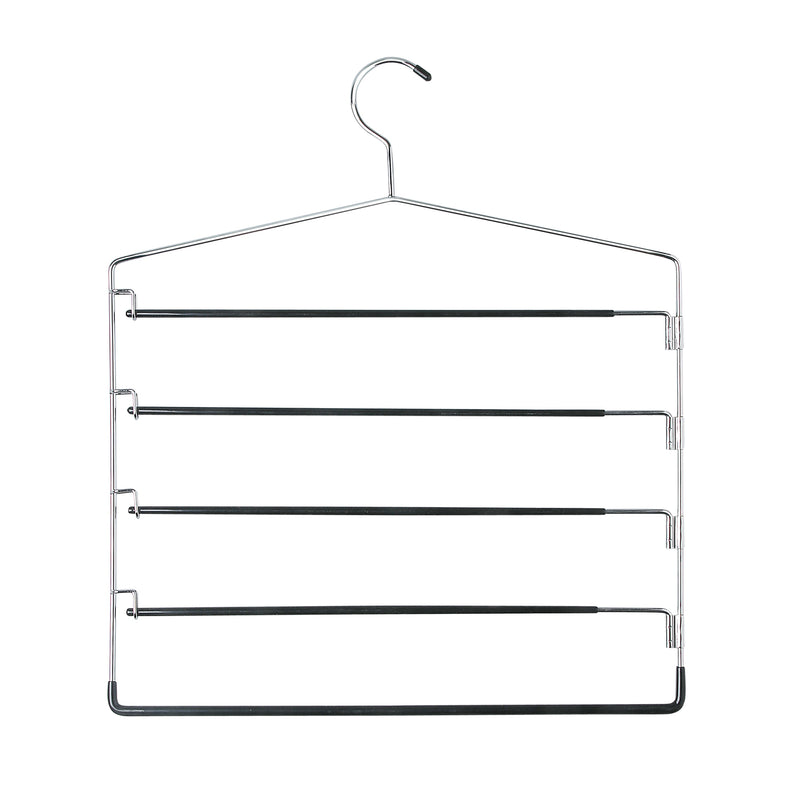
Honey-Can-Do’s HNG-09030 has five swing-out arms. The manufacturer describes metal construction and a vinyl coating to reduce slipping. Its product page showed it as sold out when checked, so it is a construction example rather than a promise of immediate availability.
Check access to the lower levels and whether the pants overlap too tightly. The hanger occupies less length along the rail, but does not remove the volume of the clothes. One hook also carries the combined weight of several pairs.
This can work for a small collection or less frequently worn items. If you use every pair regularly, individual hangers may be more convenient despite taking more rail space.
What about a shelf or drawer?
Jeans and other pants you normally fold do not have to go on a specialist fitting. A shallow stack on a shelf or an organized drawer can be easier to use if each pair is recognizable and removable without disturbing the rest.
Tall stacks create the problem: the bottom pair becomes difficult to reach. Before buying a mechanism, try smaller groups or a different shelf spacing.
What to check before choosing
Take a few pairs you actually wear and arrange them as they would hang. Measure the hanging length, folded width and room needed to remove one pair. Heavy denim behaves differently from lightweight dress pants.
Next, check the door and the movement involved: sliding forward, pivoting sideways or lifting a whole hanger off the rail. Each needs different clearance.
The most useful closet may combine several methods: dress pants with their jackets, everyday pairs on an accessible pull-out and jeans in a drawer. There is no need to force every pair into one system just to make the interior look uniform.
How do you store your pants—on individual hangers, pull-out arms or folded? What gets in the way when you take out your favorite pair?
The linked products are examples of each approach. Similar arrangements are available from other manufacturers and stores, including Amazon. Compare the mechanism, dimensions and supplied parts rather than assuming that a similar photograph means the same construction.
Sources checked 17 October 2026. Product photographs credited above. Consult the exact product’s installation instructions and the garment’s care guidance before choosing a storage arrangement.