
Pots, pans and lids are easy to group together but awkward to retrieve when everything is nested into one tall pile. Separating the everyday pieces can improve both comfort and use of space.
Below we compare divided racks, pull-out baskets and fitted drawer divisions, from a removable organizer to a cabinet mechanism that brings the back row forward.

A deep drawer brings the contents to you
A drawer with suitable extension lets you see cookware from above instead of reaching into the back of a low shelf. Arrange larger pots side by side or in small groups, keeping handles accessible.
There is no universal drawer height for cookware. Measure your tallest pot, including its lid if it will be stored that way. A low front does not establish the inside height, and a high front does not guarantee clearance beneath the cabinet structure above.
Lids upright, pots separately
Vertical dividers make it easier to select a lid without lifting the rest. They can form a side zone within a drawer; on a shelf they need a stable rack. Lid knobs increase the required space, so diameter alone is not enough.
Blum illustrates AMBIA-LINE cross divisions used for organizing pots and lids in high-fronted drawers. This is equipment selected for a particular drawer system, rather than a universal insert for every kitchen.
A freestanding rack: change without rebuilding
The rack should remain stable and let you remove an item without catching neighboring cookware. Not every divider arrangement is suitable for heavy cast iron. Check the intended use and limits of the particular product.
Similar organizers on Amazon may offer a lower-cost way to improve an existing kitchen. Appearance alone is not enough: compare base rigidity, divider attachment and actual spacing. Do not assign a familiar brand’s specifications to a lookalike product.
YouCopia StoreMore Pan & Lid Rack ↗ has an expanding base and repositionable steel dividers. It stands cookware upright rather than making a taller nest. Choose the gaps around lid knobs and pan depth; an organizer that holds flat baking sheets may still be inconvenient with a deep sauté pan.
This is a modest alteration because the rack stands on the existing surface. It is easier to change later than a custom drawer. Leave room to grip each handle and check the organizer’s intended use rather than assuming every wire divider will retain a heavy cast-iron pan.
Nesting one pot inside another
Nesting saves space, but arrange groups so that an everyday pot does not require dismantling a tower. For delicate coatings, follow the cookware manufacturer’s protection advice. A soft separator may reduce surface contact but cannot stabilize a badly arranged stack.
An occasional large stockpot can live elsewhere. It need not occupy the most convenient drawer simply because it belongs to the same category as a saucepan used every morning.
Bring a deep shelf forward
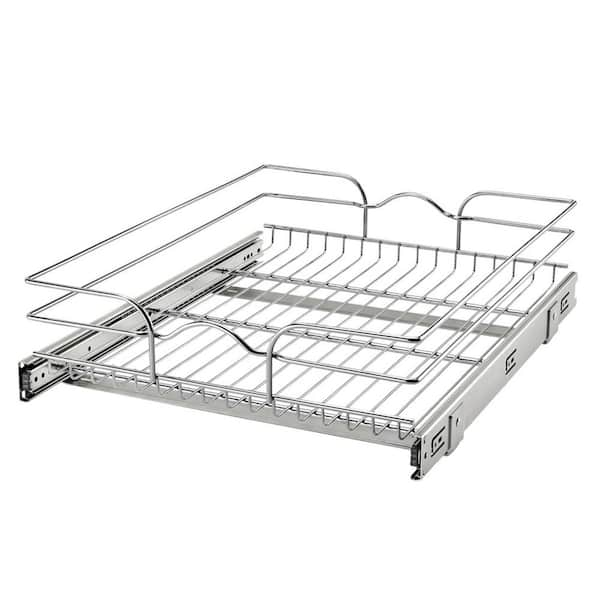
Rev-A-Shelf 5WB1 at The Home Depot ↗ illustrates a bottom-mounted wire basket on runners. It can improve access to a rear group without replacing the entire cabinet with a drawer.
The moving basket occupies some of the original shelf space and must clear hinges. Compare the exact opening, fixing surface and usable basket base. Long pan handles can extend beyond the apparent footprint, so test the loaded arrangement before choosing the wider-looking model.
Door-mounted holders: check collisions first
A lid organizer attached to a door uses a surface that may appear empty. Once closed, however, it projects into the cabinet. It may hit a shelf, pot or pull-out basket.
Check door thickness, construction and the specified fixings before installation. A screw chosen by eye may penetrate a thin panel. A no-drill holder must also fit the edge and allow the door to close properly.
Prioritize access over packing everything in
In a trial layout, remove your three most-used pieces. If that involves lifting other pots out and putting them on the floor, reconsider the division. Leaving a little open space may be more useful than filling every part of the drawer.
What is hardest to organize in your kitchen: pots, pans or lids?
The linked products are examples of different approaches. Similar solutions can be found from other manufacturers and stores. Compare the exact model, supplied components and installation requirements. Product photographs are credited to their source. This article describes functions and planning considerations, rather than a hands-on test.