
A high rail can add hanging space, but only if you can use it comfortably. A wardrobe lift brings the rail down towards you. It also needs room to move, suitable mounting panels and a clear place for the person operating it.
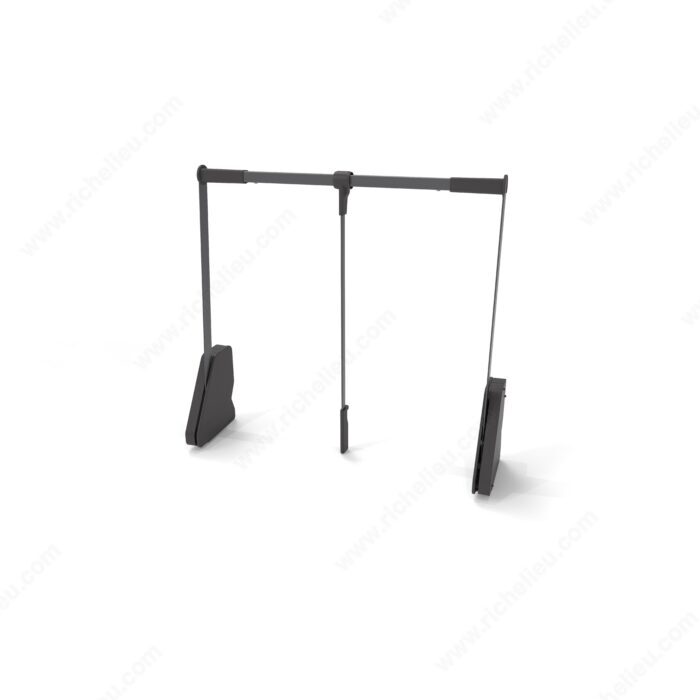
Choose what belongs upstairs
Start with the garments you would put on the upper rail. A collection of shirts presents a different load and handling task from heavy coats. Separate daily clothing from pieces you only need occasionally. A high shelf for seasonal boxes may be a better use of the same space when hanging access is rarely needed.
Keep the layout below realistic. A lift can lower into the space occupied by a drawer top, shelf contents or a second row of garments. The upper bay and lower storage must work as one arrangement, rather than being filled independently.
Understand the complete movement
A pull-down rail moves on arms; it does more than drop vertically. Ask for the installation drawing and check the path of the loaded rail, its handle and the clothes. The operating handle must be accessible when the rail is raised, without reaching through another hanging run.
Try a comparable unit if possible. The effort needed to lower and return a loaded fitting matters more than a smooth demonstration with an empty rail. Consider the user’s actual reach and grip rather than treating a wardrobe lift as an automatic accessibility solution.
A verified fitting example
The CONERO pull-down closet rod listed by Distribution 2020 is one example, with adjustable-width versions and assisted movement. Select the version using the current supplier documentation. Capacity, mounting height, internal depth and any spacers must be checked for that exact fitting; figures from another wardrobe lift are not interchangeable.
Panel material and fastening matter because the moving assembly transfers force to the cabinet. A fitting advertised for a suitable width still needs appropriate structural support. Check the instructions before adapting it to an existing wardrobe.
Compare it with the simpler layout
A fixed rail at a useful height is simpler to operate and leaves no lifting mechanism to accommodate. Another arrangement is an ordinary daily rail with clearly labelled seasonal storage above. A lower shelf or drawer may provide more practical capacity than a second hanging level.
Choose the lift when upper hanging space is valuable and the movement makes that space usable. Choose fixed storage when it better matches the garments, the user and the available clearance. A mechanism that requires you to empty the bay below each time is unlikely to improve the routine.
Before you buy
- Loaded capacity and garment length
- Handle reach in the raised position
- Movement clearance with doors and lower storage
- Mounting panels, fasteners and required spacers
Sources and product notes
Product information reviewed on October 17, 2026. Original product information and photo source ↗. Product availability, components and specifications can change. Layout comparisons are editorial guidance, not a report of a hands-on product test.