
Give appliances a place to work, cool and return without turning the counter into permanent storage.
Choose what earns a place on the counter
A clear counter is useful when it leaves room for the way you cook. List the appliances you use daily, weekly and occasionally. A kettle used throughout the day may deserve a permanent position; an occasional mixer may be better on a reachable shelf. Avoid moving a heavy appliance into an inconvenient cupboard simply to create an empty photograph.
Measure appliances with lids raised, bowls removed and handles in use. The storage footprint may be much smaller than the working footprint. Include the space needed to refill water, remove a crumb tray or carry a hot vessel to a clear landing surface.
Separate parking from operation
A shelf can be suitable for storing an unplugged appliance without being suitable for running it. Follow the appliance instructions for ventilation, heat and clearances. A toaster, kettle or coffee machine behind a closed door can require a different arrangement from a cool stored blender.
An appliance garage needs more planning than doors around an existing counter. Check cable routes, controls, access for cleaning and the required open position during use. If the appliance cannot be operated as instructed inside the enclosure, bring it to a suitable working surface.
Compare a shelf, cart and lifting mechanism
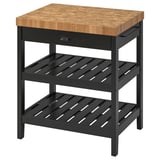
A sturdy accessible shelf is the simplest option. A cart can provide flexible storage if it has the right stability and capacity, but it also occupies a route through the kitchen. The VADHOLMA island shown is a fixed furniture example of an extra working and storage zone; it should not be described as a mobile appliance cart.
A lifting shelf may help with a heavy mixer when it is designed for that appliance load and cabinet. Account for vibration, working height and the occupied space below. Check the complete fitting instructions before treating a lifting mechanism as a general-purpose extension of the counter.
Leave a practical return route
Place frequently used accessories with the appliance: the correct bowl, blades or attachments, each stored as instructed. Avoid a layout where the machine is convenient but its parts are spread across several cupboards. Leave a place for items to dry before storage.
Try the arrangement using existing furniture first. For a week, notice what remains on the counter because returning it is awkward. Fix that specific obstacle before buying more organizers. The successful layout supports preparation and cleaning as well as storage.