
The wall above a toilet often stays empty even when a bathroom lacks room for paper, spare soap and small supplies. A cabinet can help, but excessive depth can be more intrusive than a drawing suggests.
Treat this as a possible home for light backups. It does not need to take over every task of a missing tall cabinet.
Check movement, not just an empty wall rectangle
Sit down, stand up and lean as you would during ordinary use and cleaning. Consider the cabinet’s projecting edge and open doors. It should not intrude into head space or obstruct the flush controls.
With a conventional cistern, preserve room to open and service it. With a concealed frame, keep the intended service openings accessible. A shelf above the flush plate should not obstruct its removal when needed for maintenance.
A shallow closed cabinet
Closed storage conceals supplies and reduces visual clutter. A shallow body may be enough for paper and toiletries that do not require a deep shelf. Choose dimensions around the contents rather than the largest cabinet available.
Check the door swing before buying. In a corner, a wide door may strike a wall or light. Several smaller fronts can be more convenient, although they add divisions and hardware.
Open shelves: quick access, visible contents
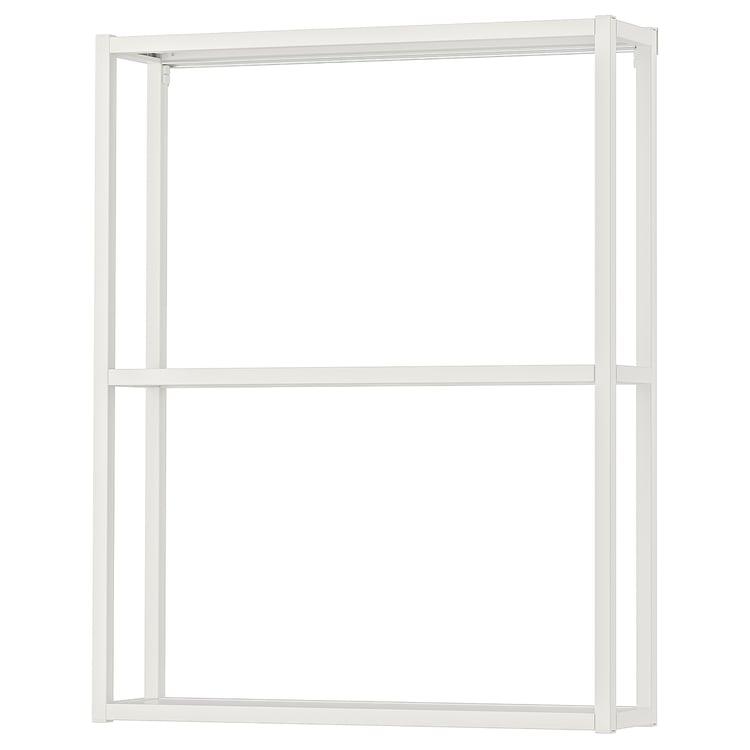
A shallow wall frame provides easy access and space for removable containers. IKEA ENHET is one example. It is not a special assembly that automatically fits above every toilet: match its dimensions and mounting position to the room.
Open shelves need regular tidying and dust removal. Protect paper supplies from splashes instead of positioning them next to a wet area. Baskets group small objects, but a container on a high shelf still has to be lowered safely.
A floor-standing over-toilet unit
A ready-made unit with legs on each side may avoid custom cabinetry. Such products are also sold on Amazon. Measure more than the toilet’s width: the tank, pipes, baseboards and the unit’s lower crossbar all matter.
Check stability and any wall attachment required by the manufacturer. ‘Freestanding’ does not mean an anti-tip restraint can automatically be omitted.
What belongs there?
Light backups and less frequently used items will generally be more suitable than heavy glass bottles. Everyday toiletries should stay within easy reach. If every item requires a step stool, the space functions more as a supply cupboard than a daily-use zone.
Fixings must suit the wall construction and actual load. A concealed toilet frame may hide services, so do not select drilling points from the tile appearance alone.
Would you prefer a closed cupboard above the toilet or open shelves with a few baskets?
Sources and product information
Product information checked October 17, 2026. Dimensions, compatibility and availability vary by model and market. Product photography is credited to its source.