
Taking a plate from a wall cabinet is not difficult for everyone. But if you regularly reach beyond a comfortable range or lift a whole stack, a base drawer may be a better home. You can see dishes from above without searching behind other objects.
Moving plates down requires checking the drawer first. Heavy tableware needs a suitable structure, and stacks should not slide freely across the bottom.
Start beside the dishwasher
Putting dishes in a drawer beside the dishwasher can reduce walking. Test the arrangement with both fronts open. A drawer blocked by the dishwasher door may work on a plan but be frustrating during unloading.
Consider standing space between appliance and cabinet, too. Plates need an easy route back into storage after washing, as well as out to the table.
Stacks on a mat: a simple start
In a drawer with sufficient load capacity, several low stacks on a slip-reducing mat can be a straightforward arrangement, particularly when the drawer is not packed tightly.
A mat is not a substitute for restraints. A tall stack may still move when a drawer closes abruptly. Leave finger clearance and avoid making heavy stacks uncomfortable to lift.
Plate holders: contain a stack and carry it
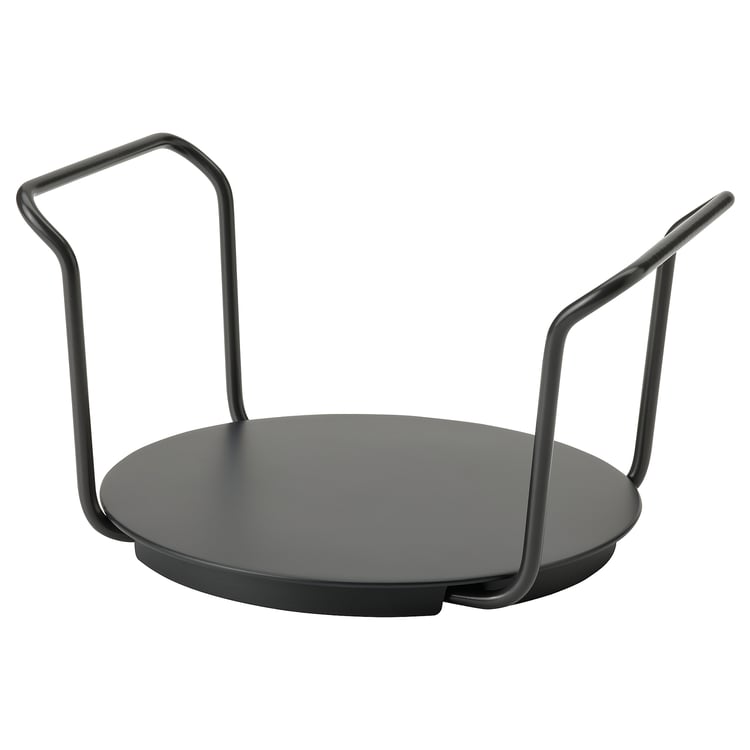
Adjustable holders surround a stack and help keep it in a defined area. Examples include the Blum plate holder and IKEA UPPDATERA. The latter is intended for a drawer or shelf and includes carrying handles.
Choose the range for your plate diameter, not just the available floor space. The holder’s outside dimensions exceed the stack itself. Allow for its height and check its rated load.
Being able to carry plates to the table does not mean you should always lift a full set. Assess the weight and your own comfort first. Two lighter groups may be more practical than one large stack.
A pegboard: divide space around different dishes
Boards with holes and repositionable pegs define areas around stacks. Rev-A-Shelf 4DPS is one example. The arrangement can also be adapted around bowls or some serving dishes.
Pegs take up space and must fit beneath the opening above the drawer. Fit the board according to the instructions for the exact version. Do not assume every product in the family can be trimmed anywhere or down to any size.
Vertical storage has different requirements
Plates can also stand between dividers, but the drawer then needs enough height for their diameter. Stable supports and an appropriate base are necessary. This is not a direct replacement for a low holder surrounding a horizontal stack.
In an existing kitchen, consider starting with an arrangement that does not require rebuilding the drawer. More expensive fittings make sense when they solve a specific problem: moving stacks, mixed diameters or awkward access.
Check the complete drawer load
Bowls, organizers and other contents add to the weight of plates. A holder’s rating does not establish the drawer’s capacity. Verify the slides and construction, particularly in an older cabinet.
Do you prefer plates on a shelf or in a drawer, and what makes that arrangement work for you?
Sources and product information
- IKEA UPPDATERA plate holder
- Blum AMBIA-LINE accessories and documentation
- Rev-A-Shelf peg system — manufacturer brochure (historical document; not current pricing)
Product information checked October 17, 2026. Dimensions, compatibility and availability vary by model and market. Product photography is credited to its source.