
The best organizer lets you see your accessories and take out one item without disturbing everything around it. Sometimes that calls for a pull-out fitting. Sometimes a simple hanger is enough.
Belts can fill a drawer even when you reach for the same few every morning. Ties disappear behind jackets or slide off a crowded hanger. Before buying another fitting, decide how you want to choose your accessories: hanging in front of you, or arranged in a shallow tray you can view from above.
1. Bring the accessories forward
A side-mounted pull-out rack attaches to a vertical cabinet panel. Its rail brings the hooks or supports toward the front, making items at the back easier to reach. When pushed in, the organizer occupies a narrow strip beside the clothes.
This makes sense when a cabinet side is available but you do not want to give up an entire drawer. The clearance needs to include the hanging belts and ties, however—not just the metal fitting. A rack that fits on paper can still interfere with clothing beneath it.
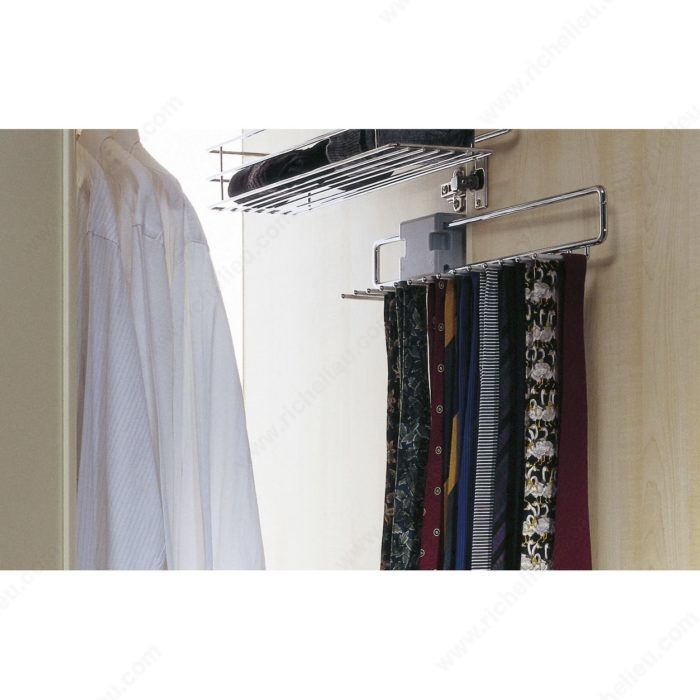
One example beyond TAG Hardware is Richelieu’s chrome 4963140 rack for belts, ties and scarves. The Division Richelieu product page specifies 14 hooks, dimensions of 74 × 455 × 118 mm and a required internal cabinet depth of 505 mm. The difference between the fitting’s length and its required installation depth is a useful reminder to read the specification rather than judge fit from a photograph.
Richelieu’s range also includes Rev-A-Shelf accessories and CONERO organizers. Compare the exact model number, mounting arrangement and required clearances: a shared collection name does not mean every version works the same way.
With hinged doors, check the path past the hinges and the open door edge. With sliding doors, check whether the exposed opening lets the rack travel fully forward. Test the proposed location with clothes in place.
2. Keep it fixed when access is already easy
A rail near the front of an accessible panel may not need a sliding mechanism. A fixed rack gives belts or ties a dedicated place with fewer moving parts.
The limitation becomes clear deeper inside a cabinet: the last hooks may be hidden behind clothing. Better access to those rear positions, rather than appearance alone, is a reason to choose a pull-out version.

Division Richelieu lists fixed Rev-A-Shelf belt and tie racks as well as its broader CONERO range. When comparing fixed and sliding products, confirm the configuration for the individual item rather than relying on the collection photograph.
3. Try a simple hanger before adding hardware
For a small collection, a multi-arm hanger can be a practical starting point. It needs no drilling, can move with your clothes and is useful in a rented home.
Budget candidates to look for on Amazon include multi-bar wooden tie hangers from Amazon Basics and rotating belt hangers from ZEDODIER. Amazon’s listings could not be checked directly during preparation, so we are not quoting a current Amazon price or promising availability. Check current Amazon listings ↗
The spacing between hooks matters more than the advertised maximum capacity. Putting several belts on each hook increases storage, but taking out the one at the back may mean moving the others. A less crowded arrangement can be easier to use every day.
A swivelling hanger changes its orientation; it does not bring everything out in front of the cabinet like a slide. Allow space for rotation and for the hanging length of your belts. Avoid squeezing the organizer between tightly packed jackets.
4. View the collection from above
A shallow drawer or pull-out tray with compartments offers a different approach. Each accessory has a defined place, and tie patterns can be compared side by side.

IKEA’s KOMPLEMENT 504.040.32 is one example designed for accessories including rolled ties. IKEA specifies use with a KOMPLEMENT pull-out tray or separately. If you plan to place it in another drawer, check its actual size and the clear height above it.
The trade-off is cabinet width. Small compartments also may not suit belts with large buckles. Lay your own accessories on a flat surface first to estimate the space each one needs. Choose a folding or rolling method appropriate to the material and its maker’s care guidance.
What should you choose?
For just a few accessories, start with a simple hanger or small fixed rail. If reaching into the cabinet is the problem, consider a pull-out rack. If comparing colours and patterns is the priority, a compartment tray may work better.
A mixed arrangement can be useful too: belts on hooks, ties in a shallow drawer, and occasional-use items outside the easiest-to-reach zone. There is no need to buy every accessory in a matching collection.
Before ordering, check five things: internal depth, clearance with the doors open, the hanging length of your accessories, the panel mounting requirements and whether one item can be removed easily. These details determine how the organizer feels in daily use.
How do you store your belts and ties—hanging in view or tucked into compartments? Share what still works after several months of use, not just on the day you organize the closet.
Sources and product details checked 17 October 2026. Product photographs credited above; no photographs of other contractors’ installations are used. Amazon examples are search candidates, not tested recommendations or verified live offers.