
How can you make better use of a closet corner? Shelves usually come to mind first: joined at the corner, fixed at a chosen height, or supported on adjustable brackets so their spacing can change later. They are a practical starting point, but there are many other possibilities.
In this guide, we also explore less obvious approaches, from simple accessories to clever mechanisms built into the cabinetry. We look at familiar and less familiar products, explain how they work, what they make easier and where their limitations lie. That way, you can decide which solution best suits your closet, needs and budget.
IDEA 01
Corner shelves: a practical starting point
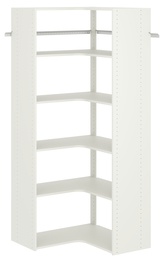
Corner shelves are the most straightforward way to use the space. They can hold folded sweaters, bags and containers without adding a moving mechanism. Their usefulness depends on their shape, height and how easily you can reach the back.
Shelves joined at the corner are often installed at fixed heights. Some form part of the cabinet structure and help keep it rigid, so they should not be moved without checking the construction. Adjustable shelves rest on suitable supports and allow the spacing to change as your storage needs change. A single unit can combine both arrangements.
Easy Track PH42-WH illustrates that combination: its six corner shelves include three fixed shelves and three adjustable shelves. The system hangs from steel wall tracks. It is one example of the shelving arrangement, rather than a reason to buy an entire matching closet.
With custom cabinetry, you can use the same principle and adapt the shelf dimensions to your room. In either case, avoid two rows of containers, one behind the other. A large shelf becomes less useful if reaching a bag at the back means removing several things in front. Check that your largest container can pass through the opening, too.
Keep in mind: Best for folded items and bags. Choose shelf depth around your reach and the things you will actually store.
Example: Easy Track Corner Tower PH42-WH at Lowe’s ↗. This is one example of this type of solution. Similar options may be available from other manufacturers and retailers; compare compatibility, dimensions and the complete installation requirements.
IDEA 02
A corner connector: a small addition instead of a rebuild
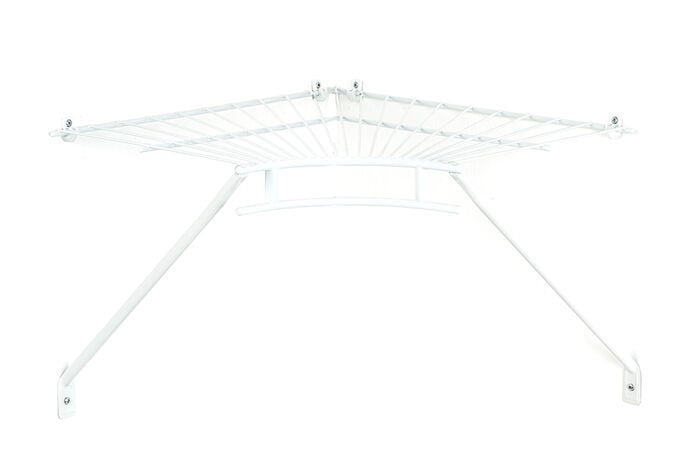
If your closet already has wire shelving, a compatible corner component may connect two existing runs without replacing the whole arrangement. It can provide a transition around the corner for the hanging area beneath the shelves.
The ClosetMaid kit shown here works with its Shelf & Rod wire shelving. The shelves are sold separately; the kit includes mounting hardware for the corner component. That distinction matters when comparing prices: this is part of a storage system, rather than a complete closet.
Identify your existing shelf profile and support arrangement before buying. A similar color or appearance does not make parts from different systems compatible. Once connected, check that thicker clothes do not bunch together around the bend. A continuous hanging path still needs room for the garments on it.
Keep in mind: A useful option when improving compatible wire shelving. Check the system, supports and space for clothes before ordering.
Example: ClosetMaid Shelf & Rod Corner Kit 2106600 ↗. This is one example of this type of solution. Similar options may be available from other manufacturers and retailers; compare compatibility, dimensions and the complete installation requirements.
IDEA 03
A curved rod: carry the hanging area around the corner
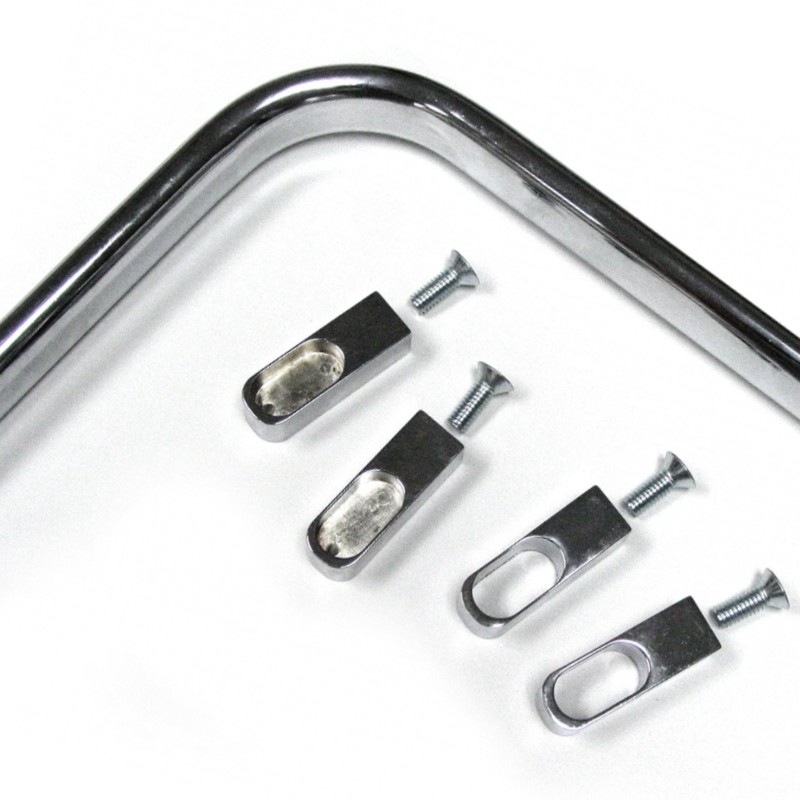
In panel-built closets, a curved rod can connect two hanging directions around the corner. It gives the hanging area a continuous shape. It does not pull clothes forward or bring a hidden row out of a deep cabinet.
The EPCO kit has a 15 × 30 mm oval profile and a curved 90-degree change of direction. The listing describes two 30-inch arms, approximately 76 cm each, together with under-shelf mounting components and supports. A coordinated kit can simplify the starting point compared with sourcing the bend alone.
The important measurement is still the space occupied by clothes. Hangers on the curve point in different directions, so extra rod length does not automatically produce proportionally more usable capacity. Try the layout with your widest hangers and bulkiest coats. Check the support positions, whether hangers can move where you need them to, and the construction into which the hardware will be fixed.
Keep in mind: Worth considering when continuous hanging is useful. It is a fixed fitting, not a mechanism for retrieving clothes from a blind corner.
Example: EPCO KIT830-90-PC at Woodworker Express ↗. This is one example of this type of solution. Similar options may be available from other manufacturers and retailers; compare compatibility, dimensions and the complete installation requirements.
IDEA 04
A rotating rack: bring shoes and bags towards you
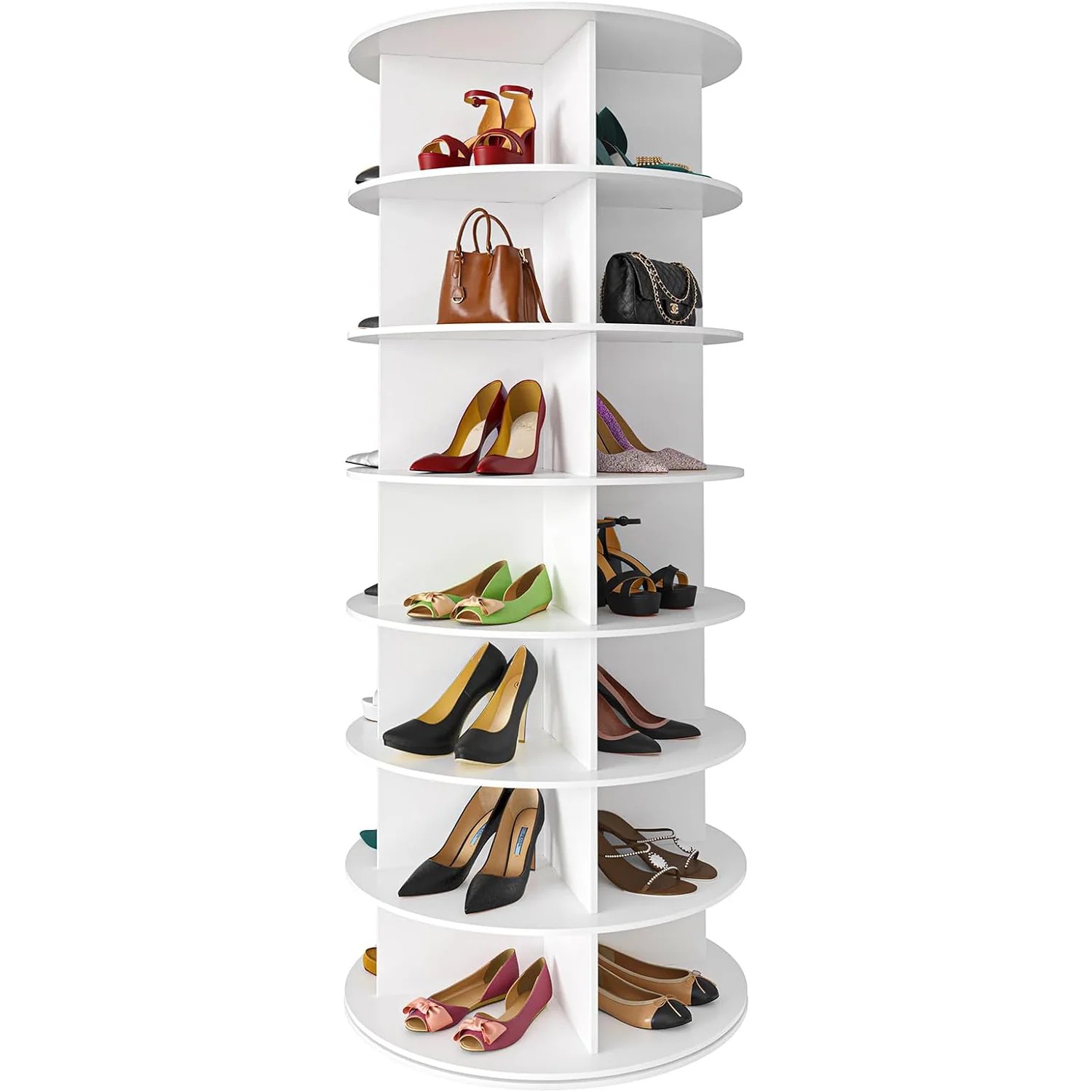
A rotating rack changes how you reach the corner: instead of reaching behind the first row of shoes, you turn the column to bring another side towards you. It can work in an open closet or a wider, accessible corner. You do not need a specially built cabinet, but you do need clear space around the rack.
The seven-tier SpaceAid example linked on Amazon measures approximately 23.2 × 23.2 inches across and 63 inches high, or about 59 × 59 × 160 cm, according to the manufacturer. Its compartments hold shoes and bags. It is not a rotating clothes rail for coats or dresses.
Mark the footprint on the floor before buying, then allow for items extending beyond the shelves. A large shoe or handbag may need additional room as the unit turns. Compare the compartment heights with your footwear: a rack suitable for flats may not accommodate tall boots in the same way.
A circular rack does not fill every part of a square corner. Its advantage is access to the contents, rather than complete use of the corner’s geometric volume. Compare that benefit with the floor space it takes up.
Keep in mind: An accessible, ready-made approach for shoes and accessories. Check the turning space with the intended contents, not just the empty rack.
Example: SpaceAid 7 Tier Rotating Shoe Rack on Amazon ↗. This is one example of this type of solution. Similar options may be available from other manufacturers and retailers; compare compatibility, dimensions and the complete installation requirements.
IDEA 05
Moving rods: reach clothes stored behind the front row
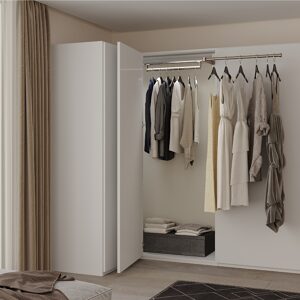
When clothes are hidden behind another hanging run, a mechanism that changes the rod’s position can be more useful than adding another fixed rail. Smart Corner combines a front rod that pivots out with a rear rod that slides forwards, giving access to the two hanging zones in sequence.
This is hardware to plan into the cabinet design. Richelieu specifies a minimum internal width of 1,560 mm, approximately 61.4 inches, for both components in their original dimensions. The rail and rear sliding rod can be shortened as described in the product information, but the front pivoting rod cannot be cut. Read the instructions for both parts before adapting the layout.
Allow room for the full movement with clothes hanging on the rods. Nearby shelving, doors and garments can obstruct a mechanism even when the metal parts fit inside the cabinet. Check the fixing points and the space where you will stand to operate it.
This is a different kind of purchase from a freestanding organizer: cabinet construction, fitting and installation all contribute to the cost. The supplier’s price requires a login, so we are not assigning a price or calling it a luxury product simply because of the brand. Ask for the cost of the complete installed arrangement and compare the access it provides.
Keep in mind: A specialist option for a planned closet where access to a hidden hanging row justifies more involved hardware and installation.
Example: Richelieu Smart Corner Closet System Kit ↗. This is one example of this type of solution. Similar options may be available from other manufacturers and retailers; compare compatibility, dimensions and the complete installation requirements.
IDEA 06
Sometimes a simpler layout is enough
Two perpendicular hanging runs compete for the same space where they meet. One straightforward option is to continue one run into the corner and stop the other before the clothes overlap. The corner then holds one layer of garments rather than two crowded layers.
Before altering the cabinetry, try the arrangement with your own jackets and coats. Move clothes away from the end of one rail and see whether the other run becomes easier to use. If it does, reorganizing may be enough for now; shortening one run can be considered during a later rebuild.
This helps when overlapping garments are the main problem. It will not solve a corner that remains too deep to reach. The last hanger still needs to be accessible, and long garments need sufficient clearance below.
Keep in mind: Start here if clothes overlap at the corner. The useful measure is how many garments you can remove comfortably, rather than the total length of rail.
Which approach fits your corner?
| Your main need | An approach to consider | What to check |
|---|---|---|
| Store folded clothes and bags | Fixed and adjustable corner shelves | Reach, shelf supports and the clear opening |
| Connect existing wire shelving | A compatible corner connector | Shelf profile, supports and garment space |
| Continue hanging around a bend | A curved closet rod | Mounting points and overlap between loaded hangers |
| Bring shoes and bags to the front | A rotating freestanding rack | Footprint, loaded turning clearance and compartment heights |
| Reach a hidden hanging row | Pivoting and sliding rods | Cabinet dimensions, full travel and installed cost |
| Stop clothes colliding in the corner | Let one hanging run continue and stop the other short | Reach and remaining usable hanging space |
Start by identifying what gets in the way: overlapping clothes, items hidden on a shelf, or storage that is too deep to reach. Then measure the opening, the space needed for movement and the space for the person using the closet. A connector, a rotating rack and a moving rod system answer different needs.
There is room for both straightforward products and more expensive designer or specialist fittings. A higher price is worth considering when a particular material, finish or mechanism delivers a benefit you want. Compare the complete installed cost and the actual improvement in access rather than judging by the brand alone.
Try the simplest arrangement first. If changing the hanging layout solves the problem, you may not need new hardware. If reach remains difficult, compare the relevant mechanism with your real clothes and everyday routine in mind.
Product references and photo credits
Product information was checked against manufacturer and retailer pages on October 18, 2026. The links and credited photographs identify representative examples, not a ranking or a record of hands-on product testing. Verify current specifications, the selected variant, availability and installation instructions before ordering.
Related guides: pants storage, ties and belts, and adjustable shelves and easier access.